Ages 5 – 17 · Homeschool or alongside school
You already know your child is capable of more than any test will measure. QMAK builds what schools skip and AI can't teach — wisdom, character, and identity — starting with fifteen minutes after a movie you were already going to watch.
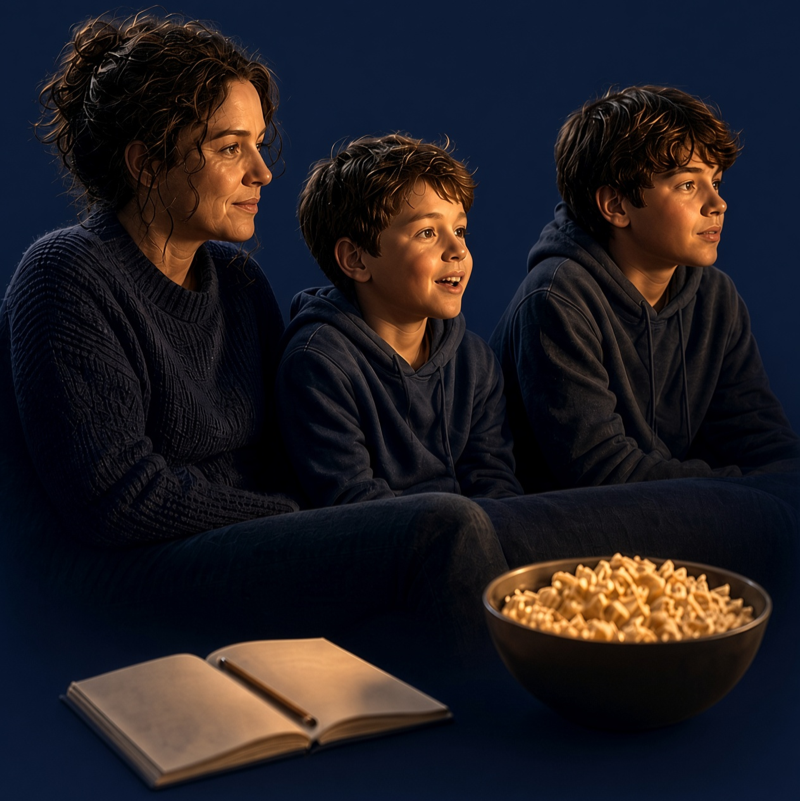
No lesson plans. No grading. You press play on a film chosen for what it teaches, watch it together, and spend fifteen minutes turning it into something your child actually does. That's the entire loop — and it repeats for thirteen years.
Choose from your grade's list — over 300 films, each chosen to teach one specific idea your child is ready for — a growth objective, a mental model, a cognitive bias or a systems-thinking concept.
Start to finish, phones away. A feature film runs 90 minutes or more, and staying with one story that long is part of the lesson. The film does the teaching; you're just in the room.
Every guide comes with up to ten discussion questions, ready to read aloud — no prep, no expertise needed.
One page, two columns, thirty seconds. This is the step that turns a nice chat into a habit — and it's shown in full below.
Everything below is taken straight from the guide a family gets for this one film. Tap through it — then download the whole thing.
Roz doesn't arrive on the island already knowing how to survive there — she arrives as a machine built for a completely different environment, with no relationships, no understanding of the island's rules, and no idea how to communicate with anything living on it. Everything she becomes — someone who can speak to animals, find food and shelter, and become a mother — she becomes by learning her environment from scratch.
A new environment doesn't bend to fit you — you learn to move within it, and it shapes who you become in the process.
That's the whole Grade 1 Environment lesson in one story: the environment of any system is everything around it, and it shapes how that system behaves — and even how natural rivals treat each other when a harsh winter arrives.
The guide maps six moments in the film to the idea at work and a question to ask. Three of them:
A new environment doesn't adjust to you — you have to learn how it works.
Have you ever been somewhere brand new where you didn't know how things worked? What did you do first?
When an environment gets harsh, the things inside it often have to cooperate — even ones that don't usually get along.
Can you think of a time when people who don't usually get along had to work together because things got hard?
Caring for something sometimes means helping it leave, not keeping it close forever.
Has there ever been something you had to let go of because it was right for it, even though it was hard for you?
Each question comes with why it matters and a follow-up, so you never have to think on your feet. Two of the six:
How do you think the animals felt when they first saw Roz?
The animals are frightened at first — she's big, metal and unlike anything they've seen. Roz becomes less scary not because she changed, but because their understanding of her did.
"If a giant robot showed up in your backyard, what would you do first — run away, watch from a distance, or try to say hello?"
How do you think Roz felt when Brightbill had to fly away?
Proud and sad at the same time — and that's completely normal. Loving someone sometimes means wanting them to go and do something important, even though you'll miss them.
"Have you ever felt happy and sad about the same thing at the same time? What was that like?"
Every guide tells you what's in the film before you press play — no surprises on the couch.
5 pages: all six moments, all six questions, a bonus activity, and a printable Active Notes page. Free to print — no email needed.
Most family movie chats evaporate by the weekend — not because the child didn't care, but because nothing happened to the idea. Active Notes is the smallest possible fix: capture what caught you on the left, turn one thing into a dated action on the right, and have someone initial it. A week later comes the only question that matters — "did you do it?"
It's your whole philosophy on one page: the left column is Question More, the right column is Action Knowledge. It closes every film, book, and big conversation from here on.
See the full Active Notes method →An example of a finished page. Yours will be messier — that's the point.
From Grade 6, children can take their One Action into ActionFlow, QMAK’s own thinking tool. It turns the page into a small cause-and-effect diagram. What must be true first. What should follow. What it might cost. Then they switch one thing off and watch the goal change.
They still write everything by hand first. ActionFlow only tests the thinking. There is no AI inside it, and nothing your child types leaves their device.
 Example: The Wild Robot · Grade 1
Try it: tap any orange or purple box to switch it off, and watch the goal.
That’s one night. The full Grade 3 curriculum is free to try.
Get the free Grade 3 pack →No credit card. No trial period. The link goes straight to your inbox.
You just watched the name work. The left column of that Active Notes page is Question More. The right is Action Knowledge. Run that loop for thirteen years.
Children who question more end up with better knowledge. Children who act on their knowledge ask better questions. Everything QMAK does is designed to keep that loop turning.
The four words behind the name →
No tests. No grades. No compliance. No IQ pedestals.
No algorithm optimising for engagement metrics.
28 growth objectives, each introduced when your child is ready for it — anchored to age, not grade. Delivered through films, original music, animated diagrams, and family conversations that actually land.
The child who memorises fastest still gets the gold star. The one who asks an unexpected question still gets called a disruption. Schools reward children for doing exactly what AI now does better — and handing them an AI tutor doesn't fix it, because a chatbot can explain any concept but can't teach a child who to become.
"AI really is the rising tide lifting all boats. It has the capacity to lift every person on Earth by levelling the playing field of IQ."— Dr Alan D. Thompson, AI researcher & former chair, Mensa International Gifted Families
If IQ is being levelled for everyone, what sets your child apart is the three things no timetable and no algorithm can hand them:
Knowing which answer to trust when every answer is available. That comes from lived experience and human judgment — not pattern-matching on training data.
Children learn values by watching people navigate hard choices. Character is forged in difficult moments — never optimised by a chatbot.
Who am I? What do I stand for? Who do I want to become? These questions need human connection and self-reflection — not autocomplete.
AI gives answers. QMAK gives your child the wisdom to use them.
The point of QMAK isn't a grade. It's the shift in how your child handles a real moment. These are the kinds of change the curriculum is built to grow.
Melts down and quits the moment a game starts going against them.
Names the frustration out loud — and chooses their next move instead of their next tantrum.
Repeats whatever opinion the group had, as if it were their own.
Starts asking, "Says who — and why should I believe them?" before agreeing with anyone.
Says "I'll do it" — and it quietly never happens.
Writes one action on their Active Notes page, gives it a date — and a week later can tell you whether they did it.
These are the shifts I spent years chasing on my own couch, with my own kids — and the reason the curriculum is shaped the way it is.
— Ian
Schools organise learning by subject. QMAK organises it by who your child is becoming. The 28 Developmental Growth Objectives are sequenced by readiness — each one introduced at the age a child can meaningfully engage with it, anchored to age rather than grade, and refined across real children. Below, the 28 are grouped into eight stages, each holding several objectives.
Building an internal compass for thoughtful decisions and recognising their own strengths.
Developing empowered responses to challenges and a desire to contribute to others.
Understanding their emotions, seeing through manipulation, and focusing on what genuinely matters.
Recognising their strengths, building healthy habits, and learning to appreciate differences in others.
Contributing to their community, finding joy in learning, and building self-worth from within.
Communicating ideas clearly, staying open to other perspectives, and managing difficult emotions.
Taking responsibility without defensiveness. Building confidence rooted in character, not comparison.
Finding genuine fulfilment, thinking independently, and extending compassion to all.
These aren't objectives your child will ever "complete." They're a spectrum — dimensions even adults are still working on. But a child who meets them early? Their blind spots won't be as blind.
The objectives are what your child develops. The libraries are where it happens.
The growth objectives are the spine. These eight libraries are how your child engages with them — through film guides, original songs, animated concept diagrams, and family conversations.
Your child builds emotional self-awareness and inner resilience — the foundation every other objective depends on.
Your child thinks in frameworks — cutting through noise to see clearly where others feel overwhelmed.
Your child sees the invisible connections — feedback loops, hidden causes, unintended consequences — that govern everything.
Your child acts with confidence under uncertainty — weighing risks and choosing wisely when others freeze.
Your child spots the hidden mental shortcuts that fool even smart adults — so they can't be easily manipulated.
Your child discovers who they actually are and what they stand for — an identity that withstands social pressure.
Family movie nights become growth experiences. Your child learns grit, empathy, and integrity through stories.
Your child understands how the real world works — value creation, marketing, sales, delivery, and finance.
Plus IdeaSpark creative challenges and printables, with new content added regularly. All yours, forever.
Every film in QMAK is chosen for what it teaches, not how popular it is. Early films focus on one clear idea. As your child grows, so do the films, bringing back objectives they first met years earlier in a story made for their age.
They’re also chosen for how they ask to be watched. More than half of QMAK’s 300+ films were released before the first iPhone, and nearly a third before 2000. The oldest, Metropolis, is from 1927. They were made for audiences who would let a scene breathe and wait half an hour for a story to find its conflict. For a child raised on clips built to hook them in three seconds, that’s hard at first. That’s the point: every film is a little more practice at staying with something.
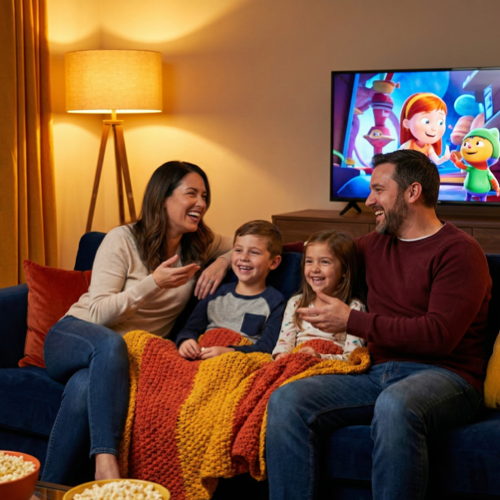
When everyone has the answers, the edge belongs to the child who can focus long enough to act on one.
I'm Ian — an Australian dad raising and homeschooling my children in the Philippines. QMAK has been about fifteen years in the making, and it started before I had kids at all.
The upper-grade material began as mentoring I did with the young adults who worked for me here in the Philippines. That's where the Grade 8–12 ideas were first worked out and tested — with people old enough to tell me plainly what landed and what didn't.
When our first child was born in 2016, we committed to homeschooling. Since then, the younger material has been built and tested on my own couch, with my own children, and rewritten based on what actually worked. My eldest three have been through it. It's shaped by real feedback loops from real people, not focus groups.
I'm not a professional educator and I've never claimed to be. I'm a father who took his children's development seriously enough to spend years building the thing I wished existed.
Young adults shaped the top of it. My own kids shaped the rest.
— Ian, Founder of QMAK
"Ian Mack has not simply created a collection of homeschool resources. He has built a thoughtful framework for helping children understand themselves, understand others, and grow into the people they are becoming… QMAK does not merely ask what children should know. It asks who they are becoming."
— Abs Lin, Untethered, a discovery platform for the future of learning
"What began as a conversation about a Bluey guide became a much deeper discovery.
The more I explored QMAK, the more I realised that Ian Mack has not simply created a collection of homeschool resources. He has built a thoughtful framework for helping children understand themselves, understand others, and grow into the people they are becoming.
QMAK makes space for the parts of education that are often difficult to measure but deeply important: identity, awareness, perspective-taking, character, wisdom, family connection, and meaningful reflection.
What makes Ian's work especially powerful is that it was built first for his own children. You can feel that care throughout the resources. The questions are thoughtful without becoming heavy. The activities invite genuine conversation without turning family life into another formal lesson. Children are not simply told what to think… They are trusted and guided to notice, question, reflect, and form their own understanding.
I was particularly moved by the way QMAK treats family as part of the learning experience. Parents are not pushed aside, and children are not left alone with a program. The resources create openings for families to know one another more deeply and to explore important ideas together.
Ian's work is intelligent, ambitious, deeply personal, and full of heart. Bluey may be the doorway through which many families first discover QMAK, but behind it is a far bigger family vision: raising children who know who they are, value one another, think independently, and move through life with grit, grace, and compassion.
QMAK does not merely ask what children should know. It asks who they are becoming."
For a lot of families, the first door into QMAK is a show they already love. Bluey episodes are about seven minutes long and quietly full of the ideas this curriculum is built on — frustration, fairness, imagination, being a good sport. We've written a discussion guide for 154 of them.
Watch one episode, ask the questions, and you've run the QMAK loop before the kettle's boiled. It's the gentlest way to find out whether this works in your house.
Bluey is owned by Ludo Studio and BBC Studios. QMAK is independent and is not affiliated with or endorsed by them.
The complete Grade 3 curriculum is free — all eight libraries, film guides, songs, animated diagrams, discussion questions, Active Notes templates. No credit card. No trial period. No catch.
Why Grade 3? Because it's the clearest window into what the curriculum contains across all thirteen years. Kindergarten is lighter by design — Grade 3 shows you the full depth of what your family gets.
Tell us where to send it and the link goes straight to your inbox. No account to create, no card, no trial clock.
Form not showing? Open it in a new tab →
Everything. Forever. No subscription.
One payment, in US dollars. Your family has it for good.
A simple promise: try Grade 3 free first. If you buy Lifetime Access and it isn't right for your family, email us within 30 days and we'll refund you in full.
A single critical-thinking course runs $200+. One month with a private tutor costs more than this — and QMAK is used until your child leaves home. Piecing together mental models, EI programs, character resources, and film-discussion guides separately would run well over $1,000, plus dozens of hours making them fit. Lifetime Family Access is the entire integrated system for $197.
Pick a film from your grade's list, watch it together, read the discussion questions aloud, and close with a one-page Active Notes reflection. Most families do this in about fifteen minutes after a movie they were already going to watch. That's the whole routine.
They're 28 developmental milestones that form the backbone of the whole curriculum — introduced at the age a child can meaningfully engage with each one, anchored to age rather than arbitrary grade levels, and refined through years of testing with real children. They range from building self-responsibility (age 6+) to unconditional compassion (age 17+). Many film guides, songs and activities map directly to them; others build the thinking tools that sit alongside them — mental models, cognitive biases and systems thinking. Full detail is on our methodology page.
The curriculum is sequential, not grade-locked. A Grade 1 child can engage with the same content as their Grade 3 sibling — ideally after working through the earlier material, since each piece builds on the last. Splitting it into individual grades would break the developmental progression that makes QMAK effective. That's also why it's one price for your whole family — every child enters the same sequence at their own starting point.
QMAK covers ages 5–17 (Grades K–12). Start wherever your child is. The sequence is designed so each objective builds on the ones before it — the exact age matters less than honouring the progression.
Not at all. The discussion questions are ready to use — press play, watch together, and start talking. You'll learn alongside your child. That's the design.
Absolutely. QMAK is the "missing layer" that complements any approach — public, private, or home. It covers the developmental dimensions schools skip entirely.
It’s screen time, but the opposite kind. Instead of an algorithm feeding short clips to one child, you choose one film for what it teaches, watch it together from start to finish, and talk about it afterwards. More than half the films were made before the smartphone, so they’re paced for patience, not for the scroll. Over time, that builds the thing endless scrolling wears down: the ability to stay with one thing.
QMAK is built on film, conversation and a pencil, and it always will be. From Grade 6, members also get ActionFlow, our own thinking tool. A child takes the One Action from their handwritten Active Notes page and turns it into a small cause-and-effect diagram they can test. It’s optional, the handwritten page always comes first, and there’s no AI inside it. Nothing your child types leaves their device. It’s included with Lifetime Family Access.
QMAK itself requires no extras. Many lessons reference films on platforms like Netflix, Disney+, or Amazon Prime — most families already have at least one. We have zero affiliate links; every film is chosen purely because it's the best tool for that lesson.
Because families shouldn't have to keep paying for their child's development like a streaming service. Pay once, have it forever — every future update included.
Try the free Grade 3 content first — that's exactly what it's there for. If you go on to buy Lifetime Access and it isn't the right fit, email us within 30 days and we'll refund you in full.
IQ has a ceiling. Character doesn't.
It starts with fifteen minutes after a movie you were already going to watch.
Get Lifetime Access — US$197 →All prices in USD · ~$15 per grade · under 40¢ per week · every child included · no subscription · 30-day refund