Raise a child’s baseline, and you change how they experience everything.
Question More and Action Knowledge are the method. Consciousness Elevation is what the method is for.
The idea has roots in work QMAK’s founder studied long before having children: Dr David R. Hawkins’ Map of Consciousness, from Power vs Force. Hawkins spent decades mapping the observation that emotional states exist on a scale — from shame, guilt, and fear at the lower end, up through courage and reason, toward love and higher states of awareness. Where a person habitually sits on that scale shapes how they interpret everything that happens to them.
Most people arrive at their baseline by accident — assembled from whatever childhood handed them. QMAK is built on a different premise: what if you could raise that baseline deliberately, starting young, sequenced to match what a child’s brain is ready for at each age?
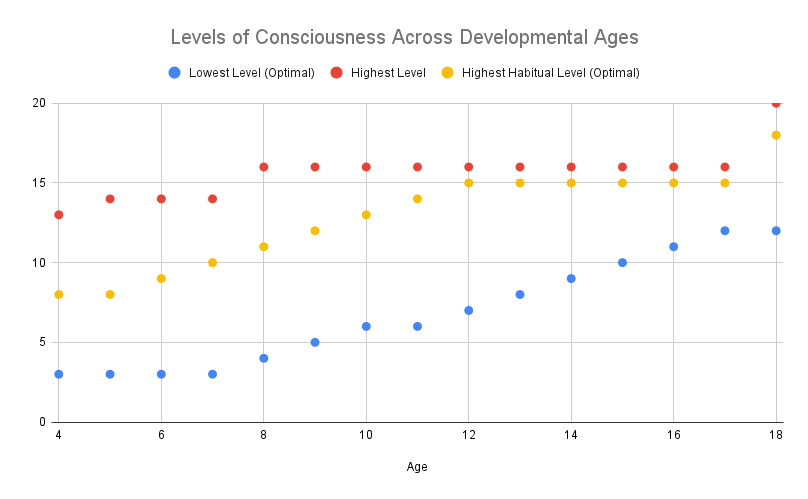
That question became the 28 Developmental Growth Objectives. And this is the moonshot, stated plainly: a child who does this work across their childhood arrives at 18 operating at a higher baseline than they would have otherwise. Not perfect. Not enlightened. Just genuinely higher — with more clarity about who they are than most adults ever reach.
Consciousness Development in Adolescence
What this looks like at each age
The sequence below maps the broad goals by stage. Each one exists to help a child move up the scale — away from the anchoring states of fear, blame, and comparison, toward courage, responsibility, and eventually something like genuine peace.
Playschool (Age 4) :
Curiosity, exploration, and creative play in a safe, nurturing environment. The goal at this age is simple: joy and security, so fear never gets an early foothold.
Kindergarten (Age 5) :
Kindness, compassion, and empathy through play and group activity, plus the first taste of achievement — the spark that makes learning feel like something worth wanting.
Grades 1 - 2 (Ages 6 - 7) :
A love of hands-on learning, cooperation, and early independence. Children begin taking genuine responsibility for small things — the foundation of personal power.
Grades 3 - 4 (Ages 8 - 9) :
Creativity, initiative, and a growth mindset. This is where children learn to face fears and setbacks as challenges rather than verdicts, and begin noticing their own emotions rather than being run by them.
Grades 5 - 6 (Ages 10 - 11) :
Critical thinking, real decision-making, and contribution to something beyond themselves. Responsibility and integrity stop being words and start being practiced.
Grades 7 - 8 (Ages 12 - 13) :
Self-awareness, humility, and authenticity — the antidotes to the pride, comparison, and criticism that adolescence serves up on schedule.
Grades 9 - 10 (Ages 14 - 15) :
Open-mindedness, self-discipline, and self-reliance. Teenagers learn to think independently of the crowd and build worth from within rather than from external validation.
Grades 11 - 12 (Ages 16 - 18) :
Purpose, meaning, and self-actualization. The final stretch aims at the top of the scale: genuine happiness, unconditional compassion, and a clear answer to who am I — before they walk out the door.
The family rises together
Here’s the part we didn’t fully anticipate when this began as one family’s homeschool project: consciousness elevation doesn’t happen to a child in isolation. Parents who sit in on these conversations end up doing the work too. The discussion questions that stretch a 9-year-old have a way of stretching a 39-year-old. Families who go through this curriculum together don’t just raise a more conscious child — they become a more conscious household.
That’s the deepest ambition of QMAK. Not a smarter child. A higher one — in a family rising alongside them.