
Most people have no idea where their time goes. They know they’re busy. They know the week flies by. But if you asked them to account for their 168 hours—the exact amount every person gets each week—they’d struggle to explain where even half of them went.
This isn’t a character flaw. It’s a skill gap. Time awareness is rarely taught, yet it’s one of the most powerful tools you can develop. “168” introduces this concept through a simple framework: becoming a time detective.
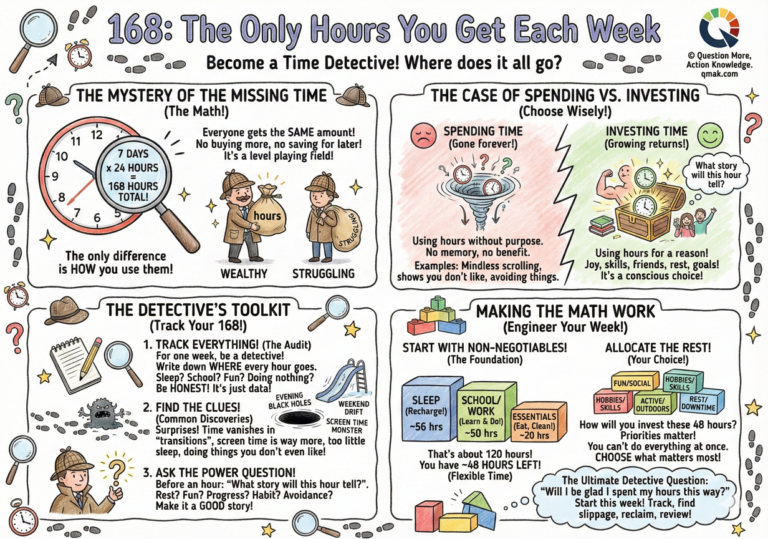
Seven days. Twenty-four hours each. That’s 168 hours. No more, no less. This isn’t flexible. You can’t buy more. You can’t save them for later. You can’t borrow from next week.
This equal distribution is one of the few truly level playing fields in life. The wealthiest person and the person struggling to pay rent both get the same 168 hours. The straight-A student and the one who’s failing both start with the same blank schedule each week.
The only difference is how those hours get used.
The song draws a critical distinction: “Are we spending time or are we investing in the life we want to create?”
Spending time means using hours without thought or purpose. The time passes, it’s gone, and you have nothing to show for it. This isn’t about relaxation or enjoyment—those can be valuable uses of time. It’s about hours that disappear with no clear benefit, no memory, no progress toward anything you care about.
Common examples:
Investing time means using hours in ways that generate returns. The return might be immediate enjoyment, skill development, relationship building, rest, progress toward goals, or experiences you’ll remember. You’re making a conscious choice about what you want those hours to produce.
The key word is “conscious.” Investment requires awareness of the trade you’re making.
You can’t improve what you don’t measure. The first step in managing your time is simply knowing where it currently goes.
For one week, become a detective. Track your hours in these broad categories:
Required Time:
Chosen Time:
Don’t change your behavior yet. Just observe. Be honest. If you spent three hours watching videos you weren’t even enjoying, write it down. The goal isn’t judgment—it’s data.
Most people find surprises when they track their 168 hours:
Time disappears in transitions. The gap between activities—getting ready, scrolling between tasks, indecision about what to do next—can consume 10-20 hours per week.
Screen time exceeds estimates. People commonly underestimate their phone and screen time by 50% or more.
Large chunks go to things they don’t value. Hours spent on obligations they resent, activities they don’t enjoy, or simply avoiding decisions.
They’re not getting enough sleep. Despite claiming they can function on six hours, their tracking reveals they’re actually getting even less—or their “sleep time” includes an hour of scrolling.
Once you know where your 168 hours go, you can see what you’re actually prioritizing versus what you think you prioritize.
If you say relationships matter most but spend 2 hours per week on meaningful connection and 20 hours on solo screen time, your stated priority doesn’t match your actual time allocation.
If you want to develop a skill but can’t find time to practice, but you can account for 15 hours of content consumption, you’ve found the time—you’re just allocating it elsewhere.
This isn’t about guilt. It’s about clarity. You can choose to keep spending time the same way, but now you’re making an active choice rather than wondering where your time went.
The song notes that “every hour tells a story of the choices that we make.” This is a powerful lens for decision-making.
Before using an hour, ask: What story will this hour tell?
Story of rest: “I was tired and recharged by doing nothing.”
Story of connection: “I deepened a relationship that matters.”
Story of progress: “I moved toward a goal I care about.”
Story of enjoyment: “I had genuine fun.”
Story of habit: “I did this because I always do.”
Story of avoidance: “I used this hour to avoid something harder.”
Story of default: “I had no better idea, so this is what happened.”
Not every hour needs to be productive. Rest, genuine enjoyment, and even some aimless wandering have value. But if most of your hours tell stories of habit, avoidance, or default, you’re not actively creating your life—you’re letting it happen to you.
The song mentions that “time just slips away until we hear the call.” This captures a common pattern: time passing without awareness until something forces you to pay attention.
Evening Black Holes: The gap between dinner and sleep where hours disappear into low-value activities.
Weekend Drift: Saturdays and Sundays that vanish without memorable activities or meaningful rest.
Transition Waste: The accumulated minutes between activities that expand into hours of scrolling, indecision, or aimless browsing.
Obligation Overflow: Saying yes to things that don’t matter, leaving no time for things that do.
False Relaxation: Hours spent on activities that aren’t restful or enjoyable—they’re just easy or habitual.
Once you know where your 168 hours go, you can start engineering your week deliberately.
Sleep: Most teens need 8-10 hours. Adults need 7-9. Let’s use 56 hours (8 per night) as a baseline.
School or Work: Full-time school/work plus commute might be 45-50 hours.
Essential Tasks: Eating, hygiene, basic maintenance might be 15-20 hours.
That’s roughly 120 hours. You have 48 hours left.
This is where choice lives. How do you want to invest these 48 flexible hours?
Some people allocate:
Others might prioritize differently. The point isn’t a perfect formula—it’s intentional allocation.
If you want to:
That’s already 36-41 hours—most or all of your flexible time. You can’t do everything. The math forces prioritization.
This isn’t discouraging—it’s clarifying. You can do many things over a lifetime. You can’t do everything simultaneously. The 168 forces you to choose.
Once per quarter, track a full week. Note patterns, slippage points, and surprises. Adjust accordingly.
Every Sunday, look at the week ahead. Identify your 3-5 most important time blocks. Protect them.
Every evening, spend three minutes reviewing: Did today’s hours tell the story I wanted? If not, what happened?
Track not just time but energy. Some hours are high-energy and worth more. Schedule your most important work during high-energy hours, not leftover low-energy time.
Identify activities that consistently feel like time you regret. Not everything—some things are obligations. But find one or two regular activities that drain time without providing value. Stop doing them.
If you’re reading this as a parent, time awareness is a gift you can give your children early.
Let your kids see you track time, make choices, and explain trade-offs. “I want to watch this show, but I also want to have energy for our game night. The show can wait.”
Create a family chart showing how everyone spends their 168. Not to judge, but to see. “Interesting—we say family time matters, but we only spend 6 hours together. Should we adjust?”
Help children see that choosing one thing means not choosing another. “You have two hours after homework. Piano practice takes one hour. That leaves one hour for gaming or friends. What do you choose?”
Notice and appreciate when your child makes intentional time choices. “You chose to finish that project instead of hanging out. That was a tough choice. How do you feel about it?”
Give children unscheduled time to experience boredom and learn to fill time themselves. This builds the muscle of intentional time use.
Here’s the question that separates time awareness from time obsession:
“If I look back on this week, will I be glad I spent my hours this way?”
Not every hour needs to be optimized. Not every day needs to be memorable. But if weeks pass and you consistently feel like your time is disappearing without purpose, you’re not actively building the life you want—you’re letting default patterns build it for you.
The 168 hours aren’t the constraint. They’re the canvas. Every week, you get a fresh one. The question is: What will you create?
You don’t need to overhaul your entire schedule. Start with awareness:
The math is simple. The practice is revealing. The results compound.
You have 168 hours. Every single week. They’re going somewhere. The only question is whether you’re choosing where, or whether habit, default, and drift are choosing for you.
Time to become a detective.
[Verse 1]
one hundred and sixty eight
That’s all the hours we get
Each and every week to use like pieces of a set
Some for sleep and some for school
Some for games and play
Let’s be time detectives now and track them day by day
Count them up
hour by hour
Where do they go?
(That gives you power)
[Chorus]
one hundred and sixty eight
That’s all we get
one hundred and sixty eight
No more no less
Every hour tells a story of the choices that we make
Are we spending time or are we investing in the life we want to create?
[Verse 2]
8 hours here for dreaming deep
6 hours there for learning
Screen time, friend time, family time, like pages we keep turning
Some surprises might appear when we add it all
Maybe time just slips away until we hear the call
[Chorus]
one hundred and sixty eight
That’s all we get
one hundred and sixty eight
No more no less
Every hour tells a story of the choices that we make
Are we spending time or are we investing in the life we want to create?
[Verse 3]
8 hours here for dreaming deep
6 hours there for learning
Screen time, friend time, family time, like pages we keep turning
Some surprises might appear when we add it all
Maybe time just slips away until we hear the call
[Chorus]
one hundred and sixty eight
That’s all we get
one hundred and sixty eight
Make it the best
Every hour has potential, every moment has its place
In this weekly puzzle we’re creating day by day
[Outro]
Now it’s your turn to solve the mystery of where your hours go and where you want them to be