
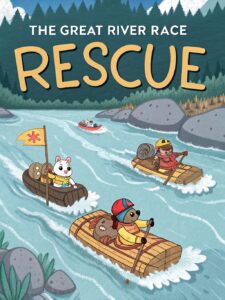
Every year in Riverdale, the animals held the Great River Race. Contestants would float downstream on homemade rafts, navigating around rocks and rapids to reach the finish line at Beaver Bay.
This year, Marco Mouse was in charge of organizing the race for the first time. He had been preparing for months, making lists, designing posters, and recruiting volunteers.
“This will be the best race ever!” Marco told his friend Greta Goose as they walked along the riverbank. “I’ve invited twice as many animals as last year!”
“Twice as many?” Greta flapped her wings nervously. “That sounds like a lot. Are you sure the river can handle that many rafts?”
Marco waved away her concern. “More racers means more fun! What could go wrong?”
On race day, the starting line was packed with excited animals on colorful rafts. There were rabbit rafts made of twigs, squirrel rafts decorated with acorn caps, and even a turtle team on a raft of sturdy leaves.
“Welcome to the Annual Great River Race!” Marco announced through a rolled-up leaf megaphone. “On your mark, get set, GO!”
The race began with cheers and splashes as the rafts set off down the river. For the first few minutes, everything seemed perfect. Spectators lined the riverbanks, cheering as the contestants paddled and floated past.
But soon, Marco noticed something strange. Just around the bend, there was a huge backup of rafts. Animals were shouting and bumping into each other, and nobody was moving forward.
“What’s happening?” Marco asked, scurrying along the shoreline to get a better look.
The problem was immediately clear. The river narrowed significantly between two large boulders, creating a tight passage that could only fit one raft at a time. With so many contestants, a massive traffic jam had formed.
“Oh no!” Marco squeaked. “It’s a bottleneck!”
He remembered learning about bottlenecks in school – how they were points in a system that limited the flow and caused backups. This narrow part of the river was definitely a bottleneck, and it was ruining his perfect race!
Greta flew over and landed beside him. “I was worried about this. The river gets very narrow here. Last year there were fewer rafts, so they could pass through one by one without much delay.”
“What do we do?” Marco asked, his whiskers drooping in disappointment. “At this rate, the race will take all day, and some contestants might give up.”
Just then, Oliver Owl swooped down from his perch in a nearby tree.
“I’ve been observing your bottleneck problem,” Oliver said wisely. “When dealing with bottlenecks, you have three options: increase capacity, improve efficiency, or manage the flow better.”
Marco’s ears perked up. “How do we do that?”
“Well,” Oliver explained, “we can’t make the river wider, so increasing capacity isn’t possible. But we can improve efficiency and manage the flow better.”
Together, they quickly developed a plan. Oliver would fly ahead and direct traffic, ensuring rafts approached the narrow passage in an orderly way. Greta and her goose friends would create a numbering system, giving each raft a turn to pass through.
Meanwhile, Marco and his mouse cousins set up a “quick check” station before the bottleneck. They made sure each raft was in good condition and properly balanced to pass through the narrow spot as quickly as possible.
“This is like the express checkout lane at the grocery store!” said Felix Fox as the mice inspected his raft.
Within minutes, the system was working beautifully. Instead of a chaotic jam, the rafts now moved through the bottleneck in an organized fashion. Oliver directed traffic, calling out, “Raft number 12, you’re up next! Raft 13, prepare to approach!”
The mice quickly fixed any issues with the rafts before they reached the narrow passage. “Your right side is too heavy,” Marco told the rabbits on raft number 15. “Shift a bit to the left so you don’t get stuck.”
Greta and her goose squad monitored the flow, making sure there was enough space between rafts. “Next raft, wait until the turtles are completely through before you start!”
As Marco watched the race continue smoothly, he realized something important: sometimes having more isn’t better if the system can’t handle it. Managing the flow properly was the key to success.
By the time the last contestant passed through the bottleneck, Marco had learned a valuable lesson. For next year’s race, he already had plans to create multiple starting waves of rafts, spaced apart to prevent bottlenecks altogether.
Later that afternoon, as the animals gathered at Beaver Bay for the award ceremony, everyone agreed it had been the best river race ever – despite the unexpected challenge.
“Three cheers for Marco and his quick thinking!” announced Mayor Badger as he presented the winner’s trophy to a family of jubilant otters.
Marco blushed as everyone cheered. “I couldn’t have fixed the bottleneck without help from my friends,” he said. “And now I know that identifying the problem is the first step to solving it.”
That evening, as the sun set over Riverdale, Marco sat with Oliver and Greta, planning next year’s race.
“You know,” said Oliver, “bottlenecks are everywhere in life, not just in rivers. The important thing is learning to spot them and find creative solutions.”
Marco nodded. “And sometimes the best solution isn’t working harder or faster, but working smarter and more efficiently.”
“Exactly,” Greta agreed. “Just like how we managed the river race today.”
As the stars began to twinkle overhead, Marco felt proud. What had started as a big problem had turned into an even bigger learning opportunity. And that, he decided, was the greatest victory of all.
The story aligns perfectly with the bottlenecks module while providing an enjoyable reading experience that elementary students can relate to and understand. The narrative encourages children to look for bottlenecks in their own lives and think creatively about solutions.