
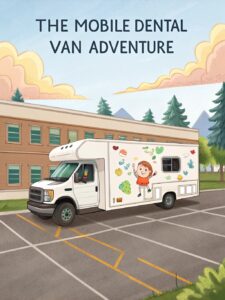
“Third graders, the Bright Smiles Dental Van is here today! When I call your name, please line up at the door,” Ms. Parker announced.
Wayne Arthurs fidgeted in his seat. He wasn’t scared of the dentist, just curious. Very curious. His mind buzzed with questions as he joined the line of students heading outside.
In the school parking lot sat a large white van with a giant smiling tooth painted on the side. Inside, it looked nothing like a van at all. It was a complete dental office on wheels, with a proper dental chair, bright lights, and all kinds of interesting equipment.
“Hello there! I’m Dr. Rivera,” a friendly woman in a white coat greeted him. “And you must be Wayne. Ready for your checkup?”
Wayne nodded, climbing into the dental chair. It was surprisingly comfortable.
“Wow, it smells nice in here,” Wayne remarked, taking a deep breath. “Not like a regular van at all. More like… mint and lemons?”
Dr. Rivera smiled. “Good nose! We use special cleaners with essential oils. Now, let me put this bib on you, and we’ll get started.”
As Dr. Rivera prepared her tools, each in their sealed packages, Wayne’s questions tumbled out.
“How many kids do you see every day? Does the van go to different schools? How do you keep everything so clean with so many kids coming through?”
Dr. Rivera laughed. “That’s quite a lot of questions! We see about 30 students each day, and yes, we visit a different school almost every day.” She snapped on a fresh pair of gloves. “As for keeping everything clean, that’s where our Standard Operating Procedures come in.”
“Standard Opera-what?” Wayne asked.
“Standard Operating Procedures. SOPs for short,” Dr. Rivera explained. “They’re like special recipes or instructions that we follow exactly the same way every single time. In healthcare, they’re super important.”
“Now, I’m going to check your teeth. Can you open wide for me?” she asked.
Wayne opened his mouth as Dr. Rivera began examining his teeth with a tiny mirror.
“Mmrggh krmmph SOPs?” Wayne attempted to ask with his mouth wide open.
Dr. Rivera chuckled. “Try not to talk while I’m looking, but I’ll tell you all about SOPs,” she said, understanding his curiosity despite his garbled speech.
As she worked, Dr. Rivera explained, “Every morning, we follow our opening procedures. We disinfect all surfaces—the chair you’re sitting in, the countertops, the equipment—everything gets cleaned according to our checklist.”
She moved the mirror to check Wayne’s back teeth. “Between every patient, we have another SOP. We dispose of anything single-use, sterilize our tools, change gloves, and disinfect the chair and surrounding areas. It’s like resetting the room each time.”
“Aaahhh,” Wayne responded, which was both acknowledgment and compliance with keeping his mouth open.
“SOPs are especially important in healthcare because they help prevent the spread of germs,” Dr. Rivera continued. “But they’re useful in all kinds of places. Do you have any routines you follow exactly the same way each time?”
When she paused her examination, Wayne quickly replied, “I guess I do when I brush my teeth. I always start with the top right, then go around to the left, then do the bottom.”
“That’s a kind of SOP!” Dr. Rivera said. “And speaking of tooth brushing, I’ve checked all your teeth now, and guess what? No cavities!”
Wayne’s face lit up. “Really? None?”
“Not a single one. You must have a very good tooth care SOP,” she said with a wink. “Brushing twice a day? Flossing?”
Wayne nodded proudly. “Every morning and night. My dad made a checklist that hangs in our bathroom. We put a sticker on it every time I brush properly.”
“That’s an excellent SOP,” Dr. Rivera said, removing her gloves and washing her hands at a small sink. “Checklists are one of the best ways to make sure nothing gets missed.”
As Dr. Rivera jotted notes in Wayne’s file, he looked around the van more carefully. “I noticed you have posters with steps on them all over the walls.”
“Good observation! Those are visual SOPs,” she explained. “They show the exact steps for different procedures so that anyone working in this van follows the same steps every time.”
Dr. Rivera pointed to a colorful chart. “This one shows our end-of-day cleaning routine. It has sixteen different steps we complete before leaving. And this one by the sink shows the proper hand-washing technique.”
“Sixteen steps just for cleaning?” Wayne’s eyes widened.
“Absolutely. SOPs need to be detailed. That way, nothing gets forgotten,” she said. “In healthcare, following these procedures can literally keep people healthy. But SOPs are helpful anywhere you want consistent results.”
As Wayne climbed down from the chair, Dr. Rivera handed him a small bag with a new toothbrush, toothpaste, and floss.
“I have one more question,” Wayne said. “Do you have an SOP for answering patients’ questions?”
Dr. Rivera laughed. “You know, we actually do! Step one: Listen carefully. Step two: Answer honestly. Step three: Keep it simple and clear. Step four: Make sure the patient understands.”
“I think you followed that SOP perfectly,” Wayne grinned.
“And here’s a sticker for being cavity-free,” Dr. Rivera said, handing him a sparkly tooth sticker. “Keep following your tooth brushing SOP, and I’ll see you next year!”
As Wayne walked back to class, he thought about all the other SOPs he could create—for packing his backpack, for setting up his desk, even for feeding his goldfish. He realized that having clear steps to follow made everything run more smoothly, just like in the dental van.
That night, Wayne proudly showed his parents the new, improved checklist he had created for his bedtime routine. At the top, in careful letters, he had written: “Wayne’s Bedtime SOP.”
His father smiled. “What does SOP stand for?”
“Standard Operating Procedure,” Wayne explained confidently. “It’s like a special recipe for doing things right every time. The dental van taught me all about them today.”
As he followed each step on his checklist, from brushing his teeth to setting out his clothes for the next day, Wayne felt a new sense of pride. Having a good SOP didn’t just keep the dental van clean—it could make all parts of life run more smoothly.
Educational Elements:
The story combines these techniques to make the concept of Standard Operating Procedures accessible and interesting to elementary school children while highlighting their importance in healthcare settings and everyday life. It encourages children to develop their own procedural thinking while making the learning process engaging and memorable.