
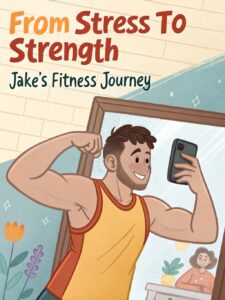
Jake Thompson stared at his reflection in the floor-to-ceiling gym mirrors, hardly recognizing himself in the loose-fitting tank top. At nineteen, he’d finally decided to do something about his lanky frame after years of being the skinniest guy on the basketball court.
“You must be Jake,” a voice called from behind him. “I’m Marcus, your personal trainer.”
Marcus looked exactly like someone who should be named “Marcus the personal trainer”—confident posture, athletic build, and a t-shirt that fit just snugly enough to show he practiced what he preached.
“First time with a trainer?” Marcus asked, extending his hand.
Jake nodded, suddenly nervous. “First time really taking the gym seriously at all.”
Marcus grinned. “Perfect. Blank slate. By summer, you won’t recognize yourself—in the best way possible.” He gestured toward the weight area. “Let’s start with some assessments.”
After checking Jake’s mobility, basic strength, and form on key movements, Marcus tapped notes into his tablet. “Alright, I’ve got a good picture of where we’re starting. Ready to begin?”
What followed was the most intense hour of physical activity Jake had ever experienced. Squats, lunges, presses, rows—Marcus introduced him to compound movements Jake had only vaguely heard about. When Jake’s form faltered, Marcus corrected him patiently but firmly.
“One more set,” Marcus would say, just when Jake thought he couldn’t possibly continue.
By the end, Jake’s legs trembled as he attempted to tie his shoelaces.
“That was… intense,” Jake managed between deep breaths.
Marcus nodded approvingly. “That’s the point. Your muscles need stress to grow—controlled stress applied in the right ways. When we challenge your muscles beyond what they’re used to, we create microscopic tears in the muscle fibers.”
“That sounds… bad?” Jake questioned, still catching his breath.
“It’s actually the beginning of getting stronger,” Marcus explained. “Your body is amazing at adaptation. These tiny tears will heal, and as they do, your body builds the muscle back stronger than before—but only if you give it proper recovery time.”
Jake wobbled to his feet. “So when’s our next session?”
“Thursday. Two days from now,” Marcus replied. “Rest tomorrow. Eat protein. Sleep well.”
Jake managed a weak thumbs-up. “Thursday. Got it.”
By Thursday morning, Jake could barely walk down the stairs in his apartment building. Every muscle screamed in protest when he moved. He’d never experienced soreness like this—not even after his most grueling basketball games.
When he arrived at the gym, Marcus immediately noticed his stiff movements.
“Feeling it, huh?” Marcus asked with a knowing smile.
“Is it supposed to hurt this much?” Jake winced. “I feel like an eighty-year-old man.”
Marcus gestured for Jake to follow him to a quieter corner of the gym. “It’s called Delayed Onset Muscle Soreness—DOMS. Totally normal, especially when you’re just starting out. How did you sleep last night?”
“Terribly,” Jake admitted. “Everything hurt too much to get comfortable.”
Marcus’s expression turned serious. “This is the most important thing I’ll teach you today: recovery isn’t optional. It’s essential. Did you know that you don’t actually get stronger during your workout?”
Jake looked confused. “What do you mean?”
“The workout—that’s the stress phase,” Marcus explained, sketching a simple diagram on his clipboard. “You’re breaking down muscle fibers, depleting energy stores, challenging your body systems. The magic happens afterward, during recovery.”
He drew an upward curve after a dip in his graph. “This is when your body repairs those micro-tears we talked about. This is when your muscles grow and strengthen. And the most powerful recovery tool you have is sleep.”
“Sleep?” Jake hadn’t expected this conversation at the gym.
“Absolutely. During deep sleep, your body releases growth hormone, regulates stress hormones, and repairs damaged tissues. Without adequate sleep, you’re sabotaging your progress before you even start your next workout.”
Jake thought about his late-night gaming sessions. “So I should…”
“Prioritize sleep like it’s part of your training program—because it is,” Marcus finished for him. “Aim for 8-9 hours. Your body is doing critical work during that time.”
Jake nodded, taking this in. “So what about today’s workout?”
“We’ll modify. I’ll show you some recovery techniques, then we’ll do a lighter session focusing on different muscle groups. That’s another key to the stress-recovery cycle—we don’t stress the same systems every day.”
Over the next three months, Jake settled into a rhythm with his training. Three sessions a week with Marcus, proper nutrition as instructed, and—most challenging of all—a consistent sleep schedule.
Each workout followed the same pattern: controlled stress, followed by strategic recovery. Marcus gradually increased the weights, added complexity to the movements, and pushed Jake’s limits—but always within a framework that allowed for proper adaptation.
“Recovery isn’t just about feeling better,” Marcus explained during their twelfth session. “It’s about supercompensation—where your body doesn’t just return to baseline but actually improves beyond your previous capacity.”
Jake began to notice changes. First in how the weights felt—movements that once seemed impossible became manageable. Then in how his clothes fit—his shoulders filling out his t-shirts, his jeans fitting differently around more developed legs.
By month three, Jake was logging every workout in his app, watching with satisfaction as his personal records climbed steadily upward. The pattern was clear: stress, recovery, adaptation, improvement—just as Marcus had outlined that first day.
“Two hundred pounds,” Marcus announced, as Jake completed his final set of squats. “That’s double what you could lift when we started.”
Jake stood up, no longer wobbling after his sets. “It doesn’t even feel that heavy anymore.”
“That’s because your system has adapted,” Marcus said. “Your muscles have grown stronger, your nervous system more efficient, your technique more refined. But none of that would have happened without the recovery periods between our sessions.”
Later that evening, looking at his progress photos side by side—day one versus now—Jake could hardly believe the transformation. His lanky frame had developed definition and strength. The basketball court wouldn’t recognize him either.
As he set his alarm for the next morning, making sure to allow for his full eight hours of sleep, Jake reflected on what he’d learned. The weights provided the stress, but the growth happened during recovery. The intense workouts created the potential, but sleep and nutrition turned that potential into reality.
It wasn’t just his body that had changed, Jake realized. He had developed a deeper appreciation for the rhythm of stress and recovery that Marcus had introduced him to—a pattern he now recognized in many aspects of life beyond the gym.
Jake closed his eyes, knowing that as he slept, his body would be hard at work, preparing him for the challenges of tomorrow—stronger, more resilient, and better adapted than before.
Educational Elements:
The story presents the stress-recovery cycle in an engaging, relatable context that readers can connect with their own experiences. By following Jake’s journey, they learn not just about fitness but about a fundamental pattern that applies across natural, technological, and social systems.