
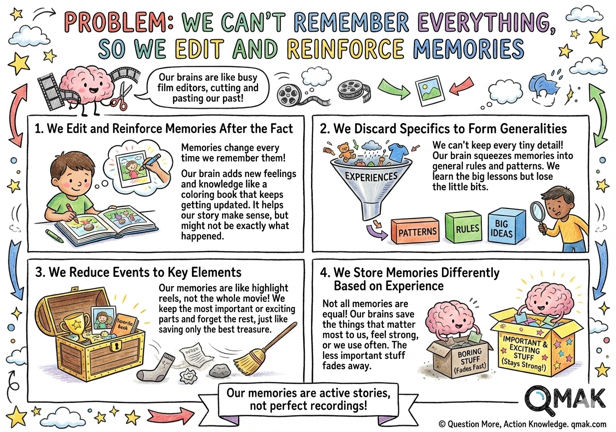
Problem: We can’t remember everything, so we edit and reinforce memories
Memory isn’t a recording device that faithfully captures and stores experiences.
Instead, it’s an active, reconstructive process that constantly edits, updates, and reorganizes information based on current needs and beliefs. We can’t possibly remember everything we experience, so our brains must decide what to keep, what to discard, and how to organize what remains.
This selection and editing process is essential for learning and functioning, but it also means our memories are far less reliable than they feel.
The biases in this category reveal how our brains curate our past experiences, creating coherent narratives that serve our present needs but may diverge significantly from historical reality.
Memories aren’t fixed records but living documents that change each time we recall them.
Our current knowledge, beliefs, and emotional states actively reshape our memories, often without our awareness. This constant editing process helps us maintain coherent life narratives and update our understanding based on new information, but it also means we can never fully trust our recollections.
These biases show how the act of remembering is actually an act of reconstruction, vulnerable to distortion at every step.
We correctly remember information but attribute it to the wrong source, time, or context.
We might remember a fact but forget whether we read it, heard it, or imagined it. A story told by one friend gets attributed to another, or a scene from a movie becomes a personal memory.
This bias is particularly problematic in eyewitness testimony, where people confidently report accurate details but place them in the wrong context. It reveals how memory separates content from context, allowing accurate information to become attached to false origins.
We confuse the sources of our memories, unable to distinguish between different origins of information.
This is closely related to misattribution but emphasizes our general difficulty in tracking where memories come from. We might blend multiple sources into one, attribute our own thoughts to others, or believe we experienced something we only heard about.
In the age of information overload, source confusion is increasingly common and problematic, affecting everything from academic integrity to the spread of misinformation.
We mistake memories for new, original thoughts, unconsciously plagiarizing ideas we’ve encountered before.
A melody we heard years ago feels like sudden inspiration, or a solution we once read seems like our own insight. This isn’t intentional theft but genuine confusion about the origin of ideas.
The bias reveals how completely we can forget the sources of our knowledge while retaining the content. It’s particularly common in creative fields and can lead to accidental plagiarism and disputes over originality.
We remember events that never occurred, often with vivid detail and strong confidence.
These aren’t lies but genuine memories that feel completely real. False memories can be implanted through suggestion, leading questions, or imagination, and once formed, they’re indistinguishable from true memories.
This bias has profound implications for legal testimony, therapy, and personal identity. It shows how memory is construction rather than recording, capable of creating entirely fictional but subjectively real experiences.
We incorporate information from external sources into our memories, especially when memories are weak or ambiguous.
Leading questions can shape eyewitness testimony, therapist suggestions can create false memories, and social pressure can alter recollections. This isn’t weakness but a normal feature of memory’s reconstructive nature. Children are particularly susceptible, but adults are also vulnerable, especially for peripheral details or emotionally charged events.
The bias reveals how social and communicative our memory systems are.
We remember information better when learning sessions are spaced out over time rather than massed together.
Studying for an hour daily over a week is more effective than seven hours in one day. This robust effect occurs because spaced repetition requires repeated retrieval, strengthening memory traces.
The bias has profound implications for education and training but is often ignored in favor of less effective cramming. It shows how memory formation benefits from time and repetition rather than intensive single sessions.
We hold unconscious associations between concepts that influence our behavior and judgments without our awareness.
These associations can contradict our conscious beliefs, linking groups with traits or concepts with emotions based on cultural exposure rather than personal experience. Implicit associations affect everything from hiring decisions to medical treatment, operating below consciousness.
The bias reveals how much of our mental life operates outside awareness, shaped by repeated cultural patterns rather than deliberate thought.
We unconsciously attribute qualities to groups based on cultural stereotypes, even when we consciously reject these stereotypes.
These automatic associations influence perception, memory, and behavior in ways we don’t intend or endorse. A resume with a typically male name might be rated higher than an identical one with a female name, despite conscious commitment to equality.
This bias shows the gap between our values and our automatic processing, requiring constant vigilance to overcome.
Our memories become distorted to fit stereotypes and expectations about groups or situations.
We remember aggressive behavior more clearly from stereotyped groups, forget counter-stereotypical information, and fill in gaps with stereotype-consistent details. This isn’t just about initial perception but how memories change over time to align with stereotypes.
The bias perpetuates stereotypes by creating false evidence that seems to confirm them, making it difficult to overcome prejudiced beliefs even with contradictory experience.
We hold preconceived opinions about groups or individuals that resist change even in the face of contradictory evidence.
These prejudgments affect what we notice, remember, and how we interpret ambiguous information. Prejudice creates self-reinforcing cycles where biased expectations shape experience, which then seems to confirm the prejudice. While often associated with negative judgments, prejudice can also involve unrealistic positive expectations.
The bias reveals how prior beliefs act as powerful filters on experience and memory.

Our brains can’t store every detail of every experience, so we compress memories by extracting general patterns and discarding specifics.
This process of abstraction allows us to learn from experience and apply knowledge to new situations, but it also means we lose vast amounts of information.
These biases show how our memory systems prioritize gist over detail, patterns over instances, and meaning over accuracy.
The emotional intensity associated with negative memories fades faster than that of positive memories.
Bad experiences lose their sting more quickly than good experiences lose their glow. This asymmetry helps maintain psychological well-being by preventing us from being overwhelmed by accumulated negative experiences. However, it can also lead to poor decision-making if we forget how bad negative experiences really were.
The bias contributes to nostalgia and the tendency to repeat mistakes.
We judge experiences largely based on their peak moment (most intense point) and how they ended, neglecting duration and other moments.
A painful medical procedure that ends gently seems better than a less painful one that ends abruptly.
This bias affects how we remember vacations, relationships, and any extended experience. It means that improving endings can dramatically improve remembered experience without changing the total amount of pleasure or pain. The rule reveals how memory compresses experience into key moments.
When storing and retelling memories, we lose distinguishing details (leveling) while exaggerating certain memorable elements (sharpening).
Stories become simpler and more dramatic over time. The fish gets bigger, the hero more heroic, the villain more villainous, while nuanced details disappear.
This process creates more memorable and tellable stories but at the cost of accuracy. It’s particularly evident in how rumors and legends evolve, becoming both simpler and more extreme with each retelling.
Post-event information alters our memories of the original event.
Hearing another witness’s account changes our own memory, news reports reshape what we remember seeing, and discussions modify our recollections. This isn’t just confusion but actual memory change: the original memory is overwritten.
The effect is stronger for peripheral details and when the misinformation comes from credible sources. It has serious implications for legal testimony and shows how malleable memories are to social influence.
We largely ignore the duration of experiences when evaluating them, focusing instead on peak and end moments.
A two-week vacation doesn’t seem twice as good as a one-week vacation if they have similar peaks and endings.
This bias affects how we make decisions about experiences, often leading us to choose brief intense experiences over longer moderate ones. It reveals how memory compresses time, storing snapshots rather than continuous experience.
We remember items at the beginning (primacy effect) and end (recency effect) of a list better than items in the middle.
This U-shaped curve appears in many contexts, from learning to speeches to experiences.
The effect shapes how we structure information for maximum impact, why conclusions and introductions are crucial, and why the middle tends to be forgotten. It reveals fundamental constraints on memory processing and storage.
The longer a list, the smaller the percentage we can recall, even though the absolute number remembered may increase.
Adding items to a list reduces the probability of recalling any specific item.
This effect shows the limited capacity of memory and how items compete for storage and retrieval resources. It has implications for everything from education (shorter focused lessons) to marketing (limited product lines).
How information is presented affects how well we remember it, with the last items in auditory lists remembered better than in visual lists.
This occurs because auditory information has a brief sensory echo that aids recall.
The effect influences instructional design and explains why verbal instructions for immediate action are effective. It reveals how different sensory systems have different memory characteristics.
Retrieving some items from memory can actually inhibit recall of related items.
Remembering some facts about a topic makes it harder to remember others, practicing some skills can temporarily worsen related ones.
This counterintuitive effect occurs because retrieval strengthens some memory traces while suppressing competing ones. It explains why partial recall can be worse than no recall and why testing needs to be comprehensive.
Items presented first in a series are remembered better than those in the middle.
First impressions really do matter more. This occurs because early items receive more rehearsal and face less interference.
The effect influences everything from interviews to product placement to legal arguments. It shows how temporal position affects memory independent of content importance.
Items presented last are also remembered better than those in the middle, though usually not as well as first items.
Recent information is still in working memory and hasn’t yet faced interference.
The effect is stronger for auditory information and weaker after delays. It explains why conclusions are memorable and why the last speaker often has an advantage. Together with primacy, it creates the serial position curve.
Being given part of a list as a retrieval cue actually impairs recall of the remaining items.
Reminding people of some facts makes them forget others. This occurs because the cued items become more accessible and block access to related memories.
The effect has implications for study methods and interrogation techniques. It shows how memory retrieval is competitive rather than independent.
Adding an irrelevant item to the end of a list dramatically reduces recall of the last few list items.
The suffix doesn’t have to be related; it just has to follow immediately.
This effect is specific to auditory presentation and reveals how sensory memory can be overwritten. It has practical implications for giving instructions or important information, suggesting we shouldn’t end with irrelevant material.
Complex experiences must be compressed into manageable memories.
Our brains do this by extracting what seems most important or representative and discarding the rest. This reduction process allows us to store and retrieve the essence of experiences efficiently, but it also means our memories are highlights reels rather than complete records.
These biases show how we prioritize certain elements while losing the texture and completeness of actual experience.
(Previously described in “We discard specifics” section)
We judge entire experiences based on their most intense moment and conclusion, ignoring most of what happened.
(Previously described in “We discard specifics” section)
We simplify complex memories by dropping details and emphasizing key elements.
(Previously described in “We discard specifics” section)
New information overwrites and replaces elements of original memories.
(Previously described in “We discard specifics” section)
We preferentially remember the beginning and end while forgetting the middle.
(Previously described in “We discard specifics” section)
We ignore how long experiences lasted when forming summary memories.

Not all memories are created equal.
How deeply we process information, how personally relevant it is, and how we’re tested on it all affect the strength and durability of memories. Our brains allocate memory resources strategically, prioritizing information that seems important while allowing other information to fade.
These biases reveal the active, strategic nature of memory formation and the factors that influence what becomes part of our long-term knowledge.
Information processed more deeply is remembered better than information processed superficially.
Thinking about meaning creates stronger memories than focusing on appearance. Words processed for their semantic meaning are recalled better than those processed for their sound or spelling.
This effect revolutionized understanding of memory, showing it’s not about repetition but depth of engagement. It has major implications for education, suggesting that meaningful engagement trumps rote memorization.
Retrieving information from memory strengthens it more than repeated studying.
Being tested on material, even without feedback, improves long-term retention more than re-reading. This counterintuitive effect occurs because retrieval is active reconstruction that strengthens memory traces. Despite robust evidence, it’s underutilized in education where re-reading remains common.
The effect shows that memory is strengthened by use, not just by input.
Lapses of attention during encoding or retrieval cause forgetting, not because memories are lost but because they were never properly formed or can’t be accessed.
We forget where we put our keys because we weren’t paying attention when we set them down. This isn’t a memory failure but an attention failure.
The bias increases with age, stress, and distraction. It reveals how memory depends on conscious attention during critical moments.
We have poor memory for events that occur just before our turn to perform.
People forget the person who spoke just before them in introductions. This occurs because anxiety about upcoming performance interferes with encoding.
The effect reveals how emotional states and future focus can prevent present attention. It has implications for sequencing in education and performance situations.
We sometimes can’t retrieve information we know we know, feeling it’s just out of reach.
We might know the first letter, number of syllables, or related information but can’t access the target.
This frustrating state reveals the complex nature of memory retrieval and how different aspects of memories can be dissociated. It increases with age and for less frequently used information. The phenomenon shows that knowing and retrieving are separate processes.
We’re less likely to remember information we believe will be available externally, offloading memory to digital devices.
We remember where to find information rather than the information itself. This “cognitive offloading” frees mental resources but makes us dependent on external tools.
The effect is changing how memory works in the digital age, creating partnerships between human and digital memory. It raises questions about what we need to know versus what we need to access.
We remember information better when it relates to ourselves or our personal experiences.
Self-referential encoding creates richer, more elaborate memory traces with more retrieval routes. This is why personal examples are memorable and why relating new information to yourself improves learning.
The effect is so strong that even imagining how something relates to you improves memory. It reveals the self as a powerful organizing principle for memory.
A4 Printable Cheatsheet
We Can't Remember Everything so we Edit And Reinforce Memories