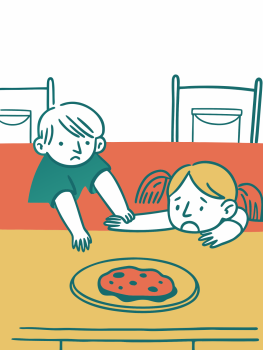
When your kids fight over who gets the last cookie, it seems obvious what the conflict is about: one cookie, two kids. When siblings argue over screen time, it appears to be a simple scheduling problem. But here’s what most parents don’t realize: these surface-level conflicts are rarely about what they seem to be about.
There’s a powerful tool from business management that can transform how your family handles disagreements – and it teaches your children sophisticated conflict resolution skills they’ll use for the rest of their lives.
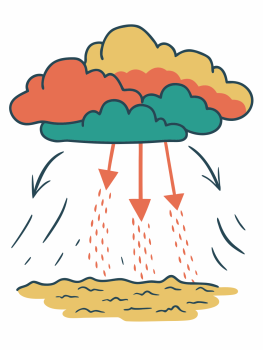
The Evaporating Cloud (sometimes called the Conflict Cloud) is a visual thinking tool that reveals the hidden structure beneath any conflict. It’s based on a profound insight: most conflicts don’t actually exist at the surface level of “what we want.” They stem from deeper underlying needs, and often there’s a common objective that both parties share but haven’t identified.
When you map this out visually, conflicts often “evaporate” – hence the name. What seemed like an impossible either/or situation suddenly reveals creative win-win solutions.
Instead of constantly playing referee or enforcing “fairness” through rules, you can teach your children to become conflict resolution experts. They learn to look beneath the surface of disagreements and find solutions that actually satisfy everyone’s deeper needs.
This isn’t just about solving today’s sibling squabble – you’re building emotional intelligence, analytical thinking, and collaboration skills that will serve them in future friendships, romantic relationships, and workplace dynamics.
How the Cloud Works
The tool maps five elements:
The magic happens when you realize that the “wants” are often just one possible way to satisfy the deeper “needs” – and there are usually other ways to meet those needs that don’t conflict.
Let’s say your two kids are fighting over who gets the tablet next:
Surface conflict: Sarah wants the tablet now, Jake wants the tablet now.
Using the Cloud:
The Breakthrough: Once you identify the real needs, new solutions emerge:
Teaching Your Children the Process
Start by modeling this approach when conflicts arise:
This tool works for any family disagreement:
Bedtime battles: Child wants to stay up late, parent wants them to sleep early.
Chore resistance: Child doesn’t want to clean room, parent wants it clean.
Children who learn this approach develop:
They enter adulthood knowing that most disagreements aren’t really about the surface issue, and that with enough creativity and empathy, most conflicts can be resolved in ways that leave everyone feeling valued and satisfied.
Making It Visual for Kids
You can actually draw this out with your children. Use simple boxes and arrows to map the wants, needs, and common objectives. Many kids are visual learners, and seeing the conflict structure helps them understand why certain solutions work better than others.
The next time a conflict erupts in your house, instead of immediately imposing a solution, try saying: “It sounds like you both want something important. Let’s figure out what each person really needs, and then see if we can find a creative solution that works for everyone.”
You might be amazed at how often the “impossible” conflict simply evaporates once everyone understands what’s really driving the disagreement.
Remember: You’re not just solving today’s argument. You’re teaching your children how to navigate every relationship conflict they’ll encounter for the rest of their lives.
Dennis and Lara sat at the kitchen table, each clutching a list of names, both looking equally determined and frustrated. Their tenth birthday was three weeks away, and what should have been excited party planning had turned into a full-scale sibling standoff.
“I need to invite everyone in my class,” Dennis said, waving his list of twenty-two names. “I can’t leave anyone out. That would be mean.”
“Well, I want to invite everyone in MY class too,” Lara countered, holding up her own list of twenty names. “Plus the kids from soccer team. It’s my birthday too!”
Mom looked at both lists and felt a familiar parenting panic. She’d already told them they could invite ten friends total—their backyard and budget couldn’t handle more than that. But both kids seemed ready to go to war over this.
Her first instinct was to split it down the middle: “Five friends each, that’s fair.” But something made her pause. She’d been reading about a conflict resolution technique called the “Evaporating Cloud,” and this seemed like the perfect time to try it.
“Okay, time out,” Mom said, sitting down between them. “Before we start making rules about who can invite how many people, I’m curious about something. It sounds like you both want something really important here. Let’s figure out what’s actually going on.”
“I want to invite my whole class,” Dennis said stubbornly.
“And I want to invite my whole class and soccer team,” Lara added.
“I hear what you want,” Mom said. “But I’m wondering about something deeper. Dennis, what would it mean to you if you could invite everyone from your class?”
Dennis thought for a moment. “It means nobody gets left out. I don’t want anyone to feel bad or think I don’t like them.”
“Ah, so you care about making sure everyone feels included and valued,” Mom reflected. “That’s really thoughtful. Lara, what about you? What would inviting everyone do for you?”
“I want it to be the best party ever!” Lara said. “With lots of people and energy and fun. I want it to be exciting, not just a small, quiet thing.”
Mom nodded. “So you want the party to feel really special and full of excitement. Both of those make perfect sense.”
She grabbed a piece of paper and started drawing. “Let me show you something interesting. You both said different things you want, but I think you might actually want the same big thing underneath.”
She drew a box at the top and wrote “Amazing 10th Birthday Celebration.”
“Do you both want to have an amazing birthday celebration that you’ll always remember?”
Both kids nodded.
“Good. Now Dennis, you said you want everyone to feel included because that’s important to you.” She drew a box and wrote “Everyone feels valued and included.”
“And Lara, you want lots of energy and excitement because that makes celebrations feel special.” She drew another box and wrote “Fun, exciting, memorable party.”
“Now, here’s where it gets interesting,” Mom continued, drawing two more boxes. “Dennis, you think the way to make everyone feel included is to invite the whole class to our house. And Lara, you think the way to make it exciting is to invite as many people as possible to our house.”
She connected the boxes with arrows, showing how their surface wants connected to their deeper needs.
“But what if there were other ways to make sure everyone feels included AND make sure the party is exciting and memorable?”
Dennis looked at the diagram, intrigued despite himself. “Like what?”
“Well, let’s think creatively. Dennis, what are some different ways to make sure everyone in your class feels valued, besides inviting them all to our house?”
Dennis was quiet for a moment, then his eyes lit up. “I could bring cupcakes to school for everyone on our actual birthday. And maybe have a little celebration there too.”
“That’s brilliant!” Mom said. “What else?”
“Or we could invite the whole class to something smaller, like… ice cream after school one day?”
Lara was getting excited now. “And for our house party, we could invite our closest friends and do really fun activities we couldn’t do with a huge group!”
“Like what?” Mom asked.
“Laser tag! We couldn’t take twenty-two kids laser tagging, but we could take eight or ten,” Lara said.
Dennis nodded enthusiastically. “And we could do escape rooms! Those are better with smaller groups anyway.”
“Wait,” Lara said, looking at her list. “What if we each invite our five closest friends to the big fun party, and then we do the school celebrations for everyone else?”
“That way everyone feels included, but we also get the exciting party we want,” Dennis added.
Mom looked at their faces, both bright with excitement now instead of frustration. “How does that solution feel to both of you?”
“It feels better than what I originally wanted,” Dennis said, surprised. “Because now I know for sure that everyone will feel included, AND we get to do really cool stuff with our close friends.”
“It feels perfect,” Lara agreed. “More fun than trying to manage a huge group, but still really special.”
“What just happened here?” Mom asked with a smile.
“We figured out what we both really wanted underneath,” Dennis said, studying the diagram. “And then we found a way to get both things.”
“Instead of fighting about inviting everyone versus not inviting everyone,” Lara added, “we found a completely different way to solve it.”
Mom nodded. “This is called the Evaporating Cloud. When it seems like two people want opposite things, often you can look deeper and find out you actually want the same big thing, just through different methods. And usually there are creative ways to satisfy both people’s real needs.”
“Can we use this for other things?” Dennis asked.
“Like when we fight about which movie to watch?” Lara suggested.
“Absolutely. Any time you think you’re stuck in an either/or situation, you can ask: What do we both really need here? And how might we get both needs met in a way neither of us thought of originally?”
Three weeks later, Dennis and Lara had the best birthday celebration they’d ever experienced. The school cupcake party made every classmate feel special and included. The laser tag adventure with their ten closest friends was exactly the exciting, memorable celebration they’d wanted. And instead of feeling like either of them had sacrificed what mattered to them, they both felt like they’d gotten something even better than they’d originally imagined.
“The weird thing,” Dennis told his friend Marcus at the laser tag arena, “is that our solution was better than what either of us wanted in the first place.”
“How?”
“Well, I wanted everyone to feel included, and this way they do—even more than if we’d just invited them to our house. And Lara wanted an exciting party, and this is way more exciting than just having a lot of people in our backyard.”
As they ran through the laser tag course, Dennis realized something important. Fighting over who was right had made both of them stuck. But when they’d worked together to understand what they both really needed, they’d found a solution that was better than either of their original ideas.
That was a skill worth remembering for the rest of his life.
And as Lara celebrated scoring the winning point in their laser tag game, she thought about how much more fun it was to create solutions together rather than battle each other for who got their way.
“Best birthday ever,” she told Dennis as they walked out.
“Definitely,” Dennis agreed. “And we figured it out ourselves.”
Mom smiled, knowing she’d given them something much more valuable than a party—she’d taught them how to transform conflicts into collaborative creativity.
That was a gift that would keep giving for decades to come.