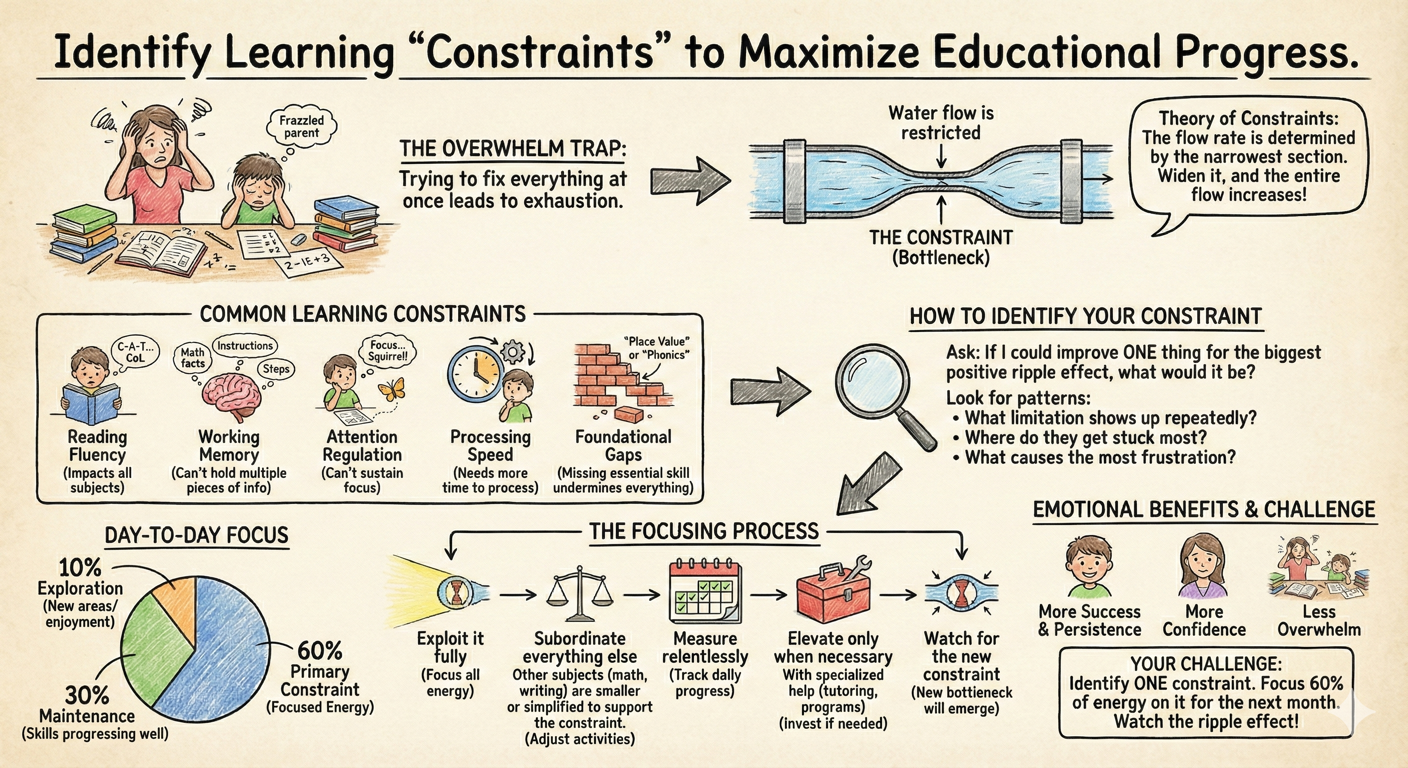
The Overwhelm Trap Most Homeschooling Parents Fall Into
You’ve probably been there: your child is struggling with reading, their handwriting is messy, math facts aren’t sticking, and they can’t sit still for more than five minutes. Your instinct? Try to fix everything at once. Get a new reading program, start handwriting practice, drill math facts daily, and implement a behavior system for focus.
Six weeks later, you’re exhausted, your child is overwhelmed, and nothing has really improved significantly.
There’s a better way – and it comes from an unexpected source: manufacturing optimization.
The Theory of Constraints for Learning
In business, there’s a powerful principle called the Theory of Constraints. It says that every system has one primary bottleneck that limits the entire system’s performance. Instead of trying to improve everything, you identify that single constraint and focus all your energy there. The result? Dramatic improvement with less effort.
This same principle can revolutionize your homeschooling approach.
Why One Constraint Changes Everything
Here’s the counterintuitive truth: your child’s learning system likely has just one or two primary constraints limiting their entire educational progress. When you identify and address that single bottleneck, everything else starts flowing more smoothly.
Think of it like water flowing through pipes of different sizes. It doesn’t matter how wide most of the pipes are – the flow rate is determined entirely by the narrowest section. Trying to widen all the pipes is exhausting and ineffective. Widen the narrowest one, and the entire flow increases dramatically.
Common Learning Constraints in Homeschooled Children
Reading Fluency: If your child is still decoding individual words, everything else becomes harder. Comprehension suffers, writing feels impossible, and even math word problems become obstacles. When reading fluency is the constraint, improving it can unlock progress across all subjects.
Working Memory: Some children can’t hold multiple pieces of information in their mind simultaneously. This affects math computation, following multi-step directions, and complex reasoning. When working memory is the constraint, strategies to support it transform learning across the board.
Attention Regulation: If your child can’t sustain focus long enough to process information deeply, all other learning becomes superficial. When attention is the constraint, addressing it first makes every other educational effort more effective.
Processing Speed: Some children understand concepts clearly but need more time to organize their thoughts and responses. When processing speed is the constraint, accommodating it reveals the child’s true capabilities.
Foundational Gaps: Sometimes there’s a specific missing skill that undermines everything else. A child who never fully learned place value will struggle with multi-digit operations, fractions, and algebra. When the foundational gap is filled, advanced learning becomes possible.
How to Identify Your Child’s Learning Constraint
Ask yourself: “If I could magically improve just ONE thing about my child’s learning, what would create the biggest positive ripple effect across all subjects?”
Look for patterns:
The Constraint in Action: Real Examples
Emma’s Story: Emma’s mom was frustrated because Emma struggled with writing, math story problems, reading comprehension, and following directions. She was trying to address all four areas simultaneously. Then she realized the constraint: Emma was still sounding out individual words when reading. Once they focused intensively on building reading fluency for three months, Emma’s comprehension improved, which made writing easier, which helped with math story problems, which improved her ability to follow complex directions. One constraint, system-wide improvement.
Marcus’s Story: Marcus seemed capable but couldn’t complete any task independently. His parents were working on time management, organization, attention, and follow-through. The real constraint? Working memory. Marcus couldn’t hold the steps of a task in his mind while executing them. Once they implemented external memory supports (visual schedules, checklists, breaking tasks into single steps), Marcus became surprisingly independent across all areas.
The Focusing Process
Once you’ve identified the constraint:
What This Looks Like Day-to-Day
Instead of a packed schedule addressing every skill gap, you might spend:
This creates steady, noticeable progress instead of the frustrating treadmill of working hard with little visible improvement.
The Emotional Benefits
When you focus on constraints, several things happen:
Common Mistakes to Avoid
Mistaking symptoms for constraints: If your child avoids math, the constraint might not be math ability – it could be reading (if word problems are involved) or working memory (if multi-step processes are involved).
Choosing too many constraints: The power comes from focusing on one, maybe two bottlenecks. Three or more means you’re back to scattered efforts.
Giving up too quickly: Real constraint improvement often takes 2-3 months of focused effort before you see dramatic system-wide changes.
Your Challenge This Week
Take an honest look at your child’s learning patterns. What one limitation, if resolved, would make the biggest positive difference across multiple areas?
For the next month, focus 60% of your educational energy on that single constraint. You might be amazed at how much everything else improves when you stop trying to fix everything at once.
Remember: You’re not neglecting other areas – you’re strategically maximizing your impact. Sometimes the fastest way to improve everything is to improve one thing really, really well.