Scott Adams, creator of Dilbert and author of influential self-improvement books, died on January 13, 2026, at age 68 from metastatic prostate cancer. In his final prepared statement, read by his ex-wife Shelly Miles, he wrote: “I had an amazing life. I gave it everything I had.” His philosophical contributions to personal development—systems thinking, talent stacking, and reframing failure—have influenced millions of readers worldwide.
Adams spent 16 years in corporate cubicles before his comic strip about a beleaguered engineer became one of the most successful in history, appearing in 2,000 newspapers across 65 countries. But beyond the satire, he developed a practical philosophy of success that resonated far beyond the funny pages. His 2013 book How to Fail at Almost Everything and Still Win Big became required reading in entrepreneurial circles, while Loserthink (2019) and Reframe Your Brain (2023) extended his mission of helping people think more clearly.
Adams’ most influential contribution to personal development was a simple but powerful insight: goals are for losers; systems are for winners.
“A goal is a specific objective that you either achieve or don’t sometime in the future. A system is something you do on a regular basis that increases your odds of happiness in the long run. If you do something every day, it’s a system. If you’re waiting to achieve it someday in the future, it’s a goal.”
The distinction matters because of how each approach affects your psychology. Goal-oriented people, Adams argued, “exist in a state of continuous pre-success failure at best, and permanent failure at worst if things never work out.” Systems people, by contrast, “succeed every time they apply their systems, in the sense that they did what they intended to do.”
This wasn’t abstract philosophy—Adams lived it. He woke at 4 AM daily to draw comics before his corporate job at Pacific Bell, following a system rather than chasing a distant goal of “becoming a cartoonist.” The system kept him productive regardless of external validation. As he put it: “The only way to succeed in the long run is by using a system that bypasses your need for willpower.”
For parents teaching children about success, this reframe is transformative. Instead of fixating on making the team or getting the grade, focus on daily practices that compound over time—reading every day, practicing a skill each morning, writing regularly. The results follow naturally.
Adams coined the concept of the “talent stack”—the idea that you don’t need world-class ability in any single area to achieve remarkable success. You simply need to combine several “good enough” skills that rarely appear together.
“If you want something extraordinary, you have two paths: 1) Become the best at one specific thing. 2) Become very good (top 25%) at two or more things. The first strategy is difficult to the point of near impossibility. Few people will ever play in the NBA or make a platinum album. I don’t recommend anyone even try.”
His own career proved the point. Adams described himself with characteristic self-deprecation: “I have poor art skills, mediocre business skills, good but not great writing talent, and a good but not great sense of humor. I’m like one big mediocre soup. None of my skills are world-class, but when my mediocre skills are combined, they become a powerful market force.”
The formula is elegantly simple: Good + Good > Excellent. Few people can draw well AND write jokes AND understand corporate dynamics from the inside. By stacking these merely “pretty good” abilities, Adams created something rare and valuable.
For young learners, this is liberating wisdom. You don’t need to be the best at anything—you need to become good at several things that work well together. Adams recommended building competence in public speaking, basic psychology, business writing, persuasion, conversation skills, and technology. “Luck has a good chance of finding you if you become merely good in most of these areas.”
Perhaps no modern thinker has written more honestly about failure than Scott Adams. His memoir is titled How to Fail at Almost Everything and Still Win Big for a reason—he experienced a remarkable string of failures before Dilbert succeeded.
His list of losses reads like a cautionary tale: failed as a banker, multiple unsuccessful corporate positions, an ill-conceived business selling Velcro bags for tennis players, significant losses investing in the grocery delivery company Webvan, a failed restaurant venture, and the “Dilberito”—a vegetarian burrito business that cost him “several years and several million dollars.”
But Adams transformed these experiences into wisdom:
“I’ve long seen failure as a tool, not an outcome.”
“Failure always brings something valuable with it. I don’t let it leave until I extract that value.”
“Over the years I have cultivated a unique relationship with failure. I invite it. I survive it. I appreciate it. And then I mug the sh*t out of it.”
His corporate career, which seemed like failure at the time, became the foundation for Dilbert’s success. “Once it became clear I would not be climbing any higher on the corporate ladder, it freed me to mock managers without worrying that it would stall my career. Most failures create some sort of unplanned freedom. I took full advantage of mine.”
The teaching for children and young people is profound: every failure contains seeds of future success. The question isn’t whether you’ll fail—you will, repeatedly—but whether you’ll extract the lessons hidden inside each setback.
In Loserthink (2019), Adams turned his attention to cognitive biases and mental traps that limit human potential. His central insight: “Being absolutely right and being spectacularly wrong feel exactly the same.”
The book introduced accessible frameworks for better thinking:
“If you can’t imagine any other explanation for a set of facts, it might be because you are bad at imagining things.”
“Confirmation bias looks exactly like knowledge gained from doing your own research.”
“There are three important things to know about human beings: Humans use pattern recognition to understand their world. Humans are very bad at pattern recognition. And they don’t know it.”
Adams championed what he called “leaving your lane”—the practice of exposing yourself to how different disciplines think. “‘Stay In Your Lane’ is the most Loserthinkish advice in history,” he wrote. “Every great innovation and development has come from people who DIDN’T stay in their lane.”
For critical thinkers of any age, his practical advice remains valuable: “Always ask yourself if the opposite of your theory could be true. Doing so keeps you humble and less susceptible to bias until you get to the truth of the situation.”
Adams’ final book, Reframe Your Brain (2023), distilled his philosophy into transformative shifts in perspective. The core premise was simple but powerful: “You can’t change the past, but you can change how you feel about it.”
Key reframes from the book include:
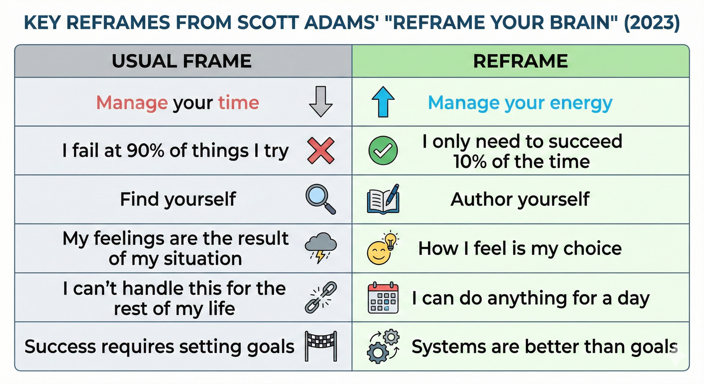
The shift from “Find yourself” to “Author yourself” captures Adams’ active approach to identity. You don’t discover who you are through passive introspection—you create yourself through deliberate choices and consistent action.
Adams offered one of the most quoted definitions of creativity in modern business literature:
“Creativity is allowing yourself to make mistakes. Art is knowing which ones to keep.”
His advice on discovering creative talent applies directly to young learners: “One helpful rule of thumb for knowing where you might have a little extra talent is to consider what you were obsessively doing before you were ten years old. There’s a strong connection between what interests you and what you’re good at.”
Perhaps most importantly for children learning to create, Adams emphasized the value of embracing embarrassment: “Learn to like embarrassment. That’s something you can learn with practice. Put yourself in embarrassing situations until you realize nobody was really hurt. Embarrassing situations are kind of fun. Everybody gives you attention. You didn’t really get hurt.”
He believed the fear of looking foolish was one of the greatest barriers to success: “I would say that probably the biggest thing that holds people back is, ‘If I do this, I’m going to look like an idiot if it doesn’t work out.'”
Adams didn’t quit his day job when Dilbert first gained traction. He worked at Pacific Bell for nearly a decade while creating the strip on mornings, evenings, and weekends. “Years ago, I engineered my routine to concentrate my creative energy into a few hours in the morning,” he explained. “Creativity is not something you can summon on command. The best you can do is set an attractive trap and wait.”
His persistence in the face of rejection was remarkable. At age 11, he applied to a program for aspiring cartoonists and received his first rejection—”You have to be at least 12 years old to be a famous cartoonist,” the letter explained. Decades later, he noted that pursuing cartooning had “about the same odds as buying a lottery ticket. And I buy a lottery ticket, so why not?”
Adams was humble about his abilities throughout his career. “I can draw better than most people, but I’m hardly an artist,” he wrote. “And I’m not any funnier than the average standup comedian who never makes it big, but I’m funnier than most people.” This honest self-assessment modeled the kind of clear-eyed self-knowledge that enables growth.
When Adams announced his Stage 4 prostate cancer diagnosis in May 2025, he approached the news with the same transparency and practicality that characterized his life’s work. He documented his journey publicly, discussing treatments, setbacks, and his evolving prognosis with his audience.
In his final months, he lost the use of his drawing hand to focal dystonia and became paralyzed below the waist. Yet he continued creating content and connecting with readers until days before his death. On January 12, 2026—the day before he died—he told fans he was “way past my expiration date.”
His prepared final statement, dated January 1, 2026, reflected the practical wisdom he’d spent decades developing: “If you got any benefits from my work, I’m asking you to pay it forward as best you can. That is the legacy I want. Be useful.”
For parents using QMAK.com to teach critical thinking and entrepreneurial mindset, Adams left a treasury of accessible wisdom:
“You should never be in a state of not learning. Period. Never have a day where you didn’t learn something. You will be amazed what that does to you. You’ll have a sense of moving in the right direction.”
“Every skill you acquire doubles your odds of success.”
“Everything you learn becomes a shortcut for understanding something else.”
“The world is like a reverse casino. In a casino, if you gamble long enough, you’re certainly going to lose. But in the real world, where the only thing you’re gambling is, say, your time or your embarrassment, then the more stuff you do, the more you give luck a chance to find you.”
“I want people to question everything. I want people to especially question the things they already think they know, because those are the most dangerous paradigms—things that you already ‘know’ to be true and turn out not necessarily always to be the case.”
“If you have a reasonable system for pursuing success, it can survive a lot of face-plants along the way. That knowledge makes success seem accessible. If you think successful people have some sort of superpower or special connections, why try?”
“Remember there’s no such thing as a small act of kindness. Every act creates a ripple effect with no logical end.”
Scott Adams leaves behind more than a beloved comic strip. He developed a coherent philosophy of practical success that helps ordinary people achieve extraordinary results—not through superhuman talent or lucky breaks, but through smart systems, stacked skills, and the courage to fail forward.
His core insights remain as relevant as ever for the AI-driven future our children will inherit: build systems rather than chase goals, combine multiple skills into a unique stack, treat failure as raw material for success, question your own assumptions ruthlessly, and never stop learning.
In his final message, Adams asked that we pay forward whatever benefits we received from his work. For parents and educators preparing young minds for an uncertain future, his books remain invaluable resources—practical, honest, and refreshingly free of pretense.
“I had an amazing life. I gave it everything I had.” Few epitaphs could be more fitting for a man who taught millions how to transform mediocrity into mastery, failure into fuel, and ordinary days into extraordinary systems.