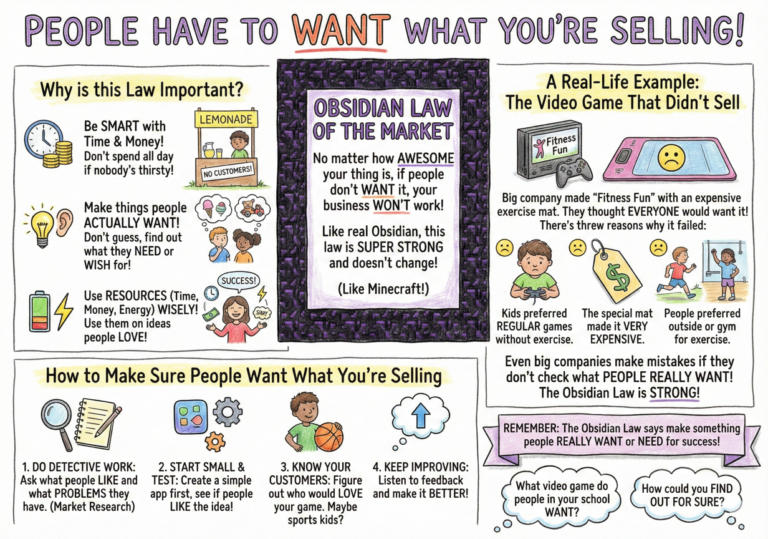


Imagine you’re setting up a lemonade stand. The Obsidian Law of the Market says that no matter how awesome your lemonade is or how cool your stand looks, if people don’t want lemonade, your business won’t work!
This law is called “Obsidian” because it’s super strong (the strongest block in Minecraft, right?) and doesn’t change, just like real Obsidian.
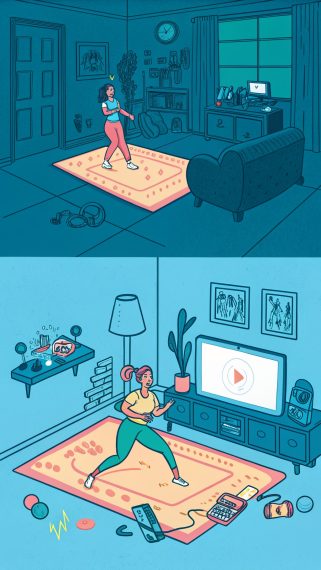
Once upon a time, a big video game company created a game they thought would be super cool. It was called “Fitness Fun” and used a special mat that players had to exercise on while playing.
The company spent lots of money making the game and the exercise mat. They thought everyone would want to play video games and exercise at the same time!
But guess what? Even though the idea seemed neat, not many people bought the game. Why? Because:
This shows how strong the Obsidian Law of the Market is! Even big companies can make mistakes if they don’t check what people really want.
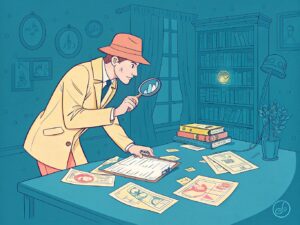
Remember: The Obsidian Law of the Market tells us that the most important thing in business is making something that people really want or need. If you do that, you’re on your way to success!
Ten-year-old Mia Chen absolutely LOVED unicorns. Her room was full of unicorn posters, her bed had unicorn sheets, and she even had unicorn socks for every day of the week. So when her school announced their first-ever Student Entrepreneur Fair, Mia knew exactly what she wanted to sell.
“Unicorn backpacks!” she announced to her family at dinner. “They’ll be the most beautiful backpacks ever created. Everyone at school will want one!”
Her older brother Kevin raised an eyebrow. “Are you sure about that?”
“Of course!” Mia said confidently. “Unicorns are magical and amazing. Who wouldn’t want a unicorn backpack?”
Mia spent the next three weeks working on her business plan. She used all her birthday money—fifty dollars—to buy fabric, rainbow thread, and sparkly unicorn patches. She even learned how to use her mom’s sewing machine.
Working every evening after homework, Mia created twelve stunning unicorn backpacks. Each one was different: purple unicorns, pink unicorns, unicorns with golden horns, and unicorns with rainbow manes. They were absolutely gorgeous.
“These are incredible, honey,” Mom said, admiring Mia’s creations. “You put so much work into them.”
“They’re going to sell out in the first hour,” Mia said proudly, pricing each backpack at fifteen dollars to make back her money.
The night before the Entrepreneur Fair, Mia carefully arranged her twelve unicorn backpacks on her display table. She made a beautiful sign that read “Magical Unicorn Backpacks – $15 Each!” with glitter letters.
But when the fair opened on Saturday morning, something unexpected happened.
The first customers walked past Mia’s table without stopping.
Then more people walked by.
And more.
After an hour, Mia had sold exactly zero backpacks.
“Maybe people haven’t seen them yet,” she told herself, moving her table to a busier spot.
But even in the new location, customers kept walking past. Some people stopped to say “How pretty!” but nobody bought anything.
Meanwhile, Mia watched other booths selling out quickly. Tommy’s table of fidget toys had a long line. Sarah’s friendship bracelet station was packed with customers. Even boring-looking Jake was selling dozens of pencil grips.
By lunchtime, Mia still hadn’t sold a single backpack. She felt confused and disappointed.
“I don’t understand,” she said to her friend Anna, who stopped by the booth. “These backpacks are beautiful. Why doesn’t anyone want them?”
Anna looked at the unicorn backpacks thoughtfully. “They really are pretty, Mia. But… well, I already have a backpack I like. And honestly, I’m not really into unicorns anymore. That was more of a second-grade thing for me.”
Mia’s heart sank. “But unicorns are amazing!”
“For you, yes,” Anna said gently. “But not everyone loves the same things you do.”
That afternoon, Mia decided to become a detective. Instead of sitting sadly behind her table, she walked around the fair asking questions.
“Excuse me,” she said to a group of fourth-graders. “Can I ask what kind of stuff you like to buy?”
“Cool stickers for my laptop,” said one girl.
“Snacks,” said a boy. “I’m always hungry after school.”
“Things for my room that aren’t too babyish,” said another girl.
Mia continued her investigation. She asked fifth-graders, third-graders, and even some parents.
The pattern became clear: almost nobody mentioned unicorns. In fact, many of the older kids said unicorns were “for little kids.”
“I wish I had known this three weeks ago,” Mia sighed.
At Tommy’s fidget toy booth, she asked, “How did you know kids would want these?”
“I didn’t just guess,” Tommy explained. “First, I noticed kids at school were always fidgeting with pens and paper clips. Then I asked my whole class what they wished they had to keep their hands busy. Almost everyone said they wanted something small and fun to play with during quiet work time.”
Mia nodded, writing notes in her phone. “So you found out what people wanted before you made anything?”
“Exactly! My dad calls it ‘market research,'” Tommy said. “You have to make sure people actually want what you’re selling, or you’ll waste your time and money.”
Mia visited Sarah’s bracelet station next.
“How did you know friendship bracelets would be popular?” Mia asked.
“I tested the idea first,” Sarah explained. “I made five bracelets and brought them to school. Kids kept asking where they could get them. When fifteen people asked me to make bracelets for them, I knew I had a good business idea.”
“You tested it small before going big,” Mia realized.
“My mom taught me that. She said even huge companies test their ideas before spending lots of money.”
By the end of the day, Mia had sold only two unicorn backpacks—both to first-graders whose moms thought they were cute.
That evening, Mia sat in her room surrounded by ten unsold unicorn backpacks, feeling pretty discouraged.
“I learned something important today,” she told her family at dinner. “Just because I love something doesn’t mean everyone else will want to buy it.”
“That’s a really valuable lesson,” Dad said. “What would you do differently next time?”
“First, I’d ask people what they actually want,” Mia said. “No more guessing. And I’d test my idea small before spending all my money.”
Kevin smiled. “So what do kids at your school actually want?”
Mia pulled out her phone notes. “Phone accessories that aren’t too expensive. Fun snacks. Room decorations that are cool but not babyish. And lots of kids said they wanted better ways to organize their school supplies.”
“Those sound like real opportunities,” Mom said.
“The unicorn backpacks taught me about something called the Obsidian Law of the Market,” Mia continued. “My teacher explained that it means people have to actually want what you’re selling, no matter how cool you think it is. It’s like the strongest rule in business—you can’t break it.”
Three months later, Mia was ready for the spring Entrepreneur Fair. This time, she had a booth selling “Student Survival Kits”—small pouches with colorful pens, fun erasers, mini staplers, and cute sticky notes.
But before making fifty kits, Mia had done her detective work. She’d surveyed two entire classes about what school supplies they wished they had. Then she’d made five sample kits and let classmates try them for a week.
The feedback was clear: kids loved the idea and wanted to buy them.
On fair day, Mia’s Student Survival Kits sold out in two hours.
“I can’t believe how different this feels,” Mia told her family that evening, counting her profits. “Last time, I made something I loved and hoped other people would want it. This time, I found out what people wanted and then made that.”
“What’s the difference in how you feel?” Mom asked.
“Confident instead of worried,” Mia replied. “When you know people want what you’re selling, business is actually fun!”
Later that night, Mia looked at her remaining unicorn backpacks. She didn’t regret making them—they’d taught her one of the most important lessons in business.
“The Obsidian Law of the Market,” she whispered, writing it in her business journal. “People have to want what you’re selling. Figure out what they want first, then make that.”
And with that hard-earned wisdom, Mia was already planning her next business—one that would definitely pass the market test.
As for the unicorn backpacks? Mia decided to keep her favorite one and donate the rest to the first-grade classes, where they were received with absolute delight.
Sometimes the best business lesson is learning that not every beautiful idea is a successful business idea. But when you find something people really want? That’s when the magic happens.
Verse 1:
Set up my stand, got my lemonade
Thought I’d make it big, be the talk of the trade
But nobody’s buying, what did I do wrong?
Gotta learn the lesson, make my business strong
Pre-Chorus:
It’s not about what I think is cool
It’s about what they want, that’s the golden rule
Chorus:
Gotta want it, want it, want it
That’s the iron law, can’t ignore it
Do your research, ask around
Or your big ideas might hit the ground
Gotta want it, want it, want it
Make something they need, or they won’t support it
Verse 2:
Like the Segway story, tech so sleek
But the price was high, and the need was weak
So before you dive in, take a look around
What do people need in this part of town?
(Pre-Chorus)
(Chorus)
Bridge:
Start small, test it out
Listen close, clear out the doubt
Know your crowd, make it great
That’s how you’ll really resonate
(Chorus)
Outro:
Remember the law, iron-strong and true
Give ’em what they want, and they’ll come to you