Building mindful approaches to learning and consumption in children is a fundamental aspect of their development that goes far beyond simply completing assignments or consuming content.
It’s about helping children develop the internal awareness that guides them to engage more deeply, appreciate the learning process, and make thoughtful choices about how they use their time and attention.
For children as young as 8, developing slower, more deliberate approaches creates a foundation for deeper understanding, greater creativity, and more meaningful engagement with both learning and leisure activities.
This guide offers research-based strategies and practical activities that help cultivate these essential skills through engaging, age-appropriate approaches.
Helping children develop slower, more mindful approaches to learning and consumption:
Understanding how our brains process information can help children develop more effective approaches to learning and attention. The Brain Games episode “Pay Attention!” offers an engaging exploration of how our focus works, its limitations, and how easily it can be manipulated or diverted.
Through interactive experiments and demonstrations, children discover fascinating concepts like selective attention, change blindness, inattentional blindness, and the myth of multitasking. They learn that our brains can only process limited information at once, making focus a precious resource rather than an unlimited ability. As children participate in the episode’s attention challenges, they experience firsthand how concentration can be disrupted, how we often miss obvious details even when nothing is hidden from view, and why slowing down and focusing on one thing at a time actually helps us process information more effectively.
These scientific insights help children understand why rushing through schoolwork or rapidly consuming content online often leads to shallow understanding, empowering them to make more deliberate choices about where they direct their focus for deeper learning and more meaningful experiences.
Episode: Pay Attention!
Demonstrates how attention can be manipulated and the limitations of our focus, often through engaging experiments and demonstrations.
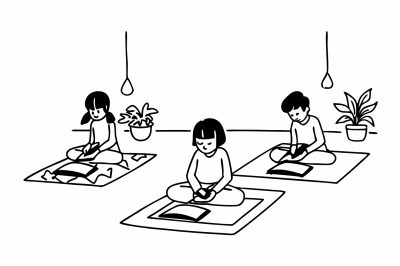
Mindfulness and patience practices help children learn the value of slowing down, being present in the moment, and appreciating the process of learning and growing, not just the outcomes (Black et al., 2017).
Through guided mindfulness activities and patience-building experiences, children learn to:
Episode: Sticky Gecko
Season 2, Episode 12
Chilli is trying to get Bluey and Bingo out the door for a playdate, but the kids keep stalling — one more game, one more thing to show her, one more reason to stay. Chilli’s frustration builds as the clock ticks, but through the chaos of delays and miscommunication, something shifts. The kids aren’t being defiant. They’re just living at a different speed — one where the moment they’re in matters more than the one they’re headed to.
Focusing on depth rather than breadth in learning activities reinforces the importance of taking the time to fully understand and appreciate a subject, highlighting the benefits of slowing down and focusing (Erus et al., 2015).
This strategy helps children:
Episode: Army
Season 2, Episode 16
Jack is new at school and struggles to follow instructions and stay focused. He joins Rusty’s army game, where the rules are clear and the missions require concentration and teamwork. Through the structure of the game, Jack discovers that he can focus when the task is meaningful to him — and that pushing through difficulty builds a kind of confidence he didn’t know he had.
Time management skills help children understand that slowing down and focusing on one task at a time can be more productive and fulfilling than rushing through activities (Maguire et al., 2018).
These activities help children:
Episode: Trains
Season 2, Episode 15
Bluey and Bingo set up an elaborate game involving a pretend train, a daycare, and a vet clinic — all running at the same time. They have to manage multiple timelines, keep track of different tasks, and figure out what needs to happen first, next, and last. Bandit helps guide the chaos, but the kids are the ones learning — through play — how to juggle priorities without losing track of what matters.
Reflection helps children understand the value of their experiences and how taking the time to think and process can enhance their learning and development (Song et al., 2015).
This strategy helps children:
Episode: Queens
Season 2, Episode 23
Bluey plays at being a queen, but discovers that being in charge isn’t all crowns and commands. Real queenship — the kind worth having — involves responsibility, hard work, and difficult decisions. Through the game, Bluey reflects on what leadership and reward actually mean, arriving at a deeper understanding that the things most worth having usually require the most effort.
Each strategy section includes detailed activities, implementation guides, and tips for success.
Choose activities based on:
Remember that helping children learn to slow down is a gradual process that requires:
Select any of the four strategy sections above to find detailed activities and implementation guides. Each section provides practical tools and approaches that you can start using today to help your child develop slower, more mindful approaches to learning and consumption.
Remember: The journey toward more mindful learning and consumption unfolds over time through consistent practice, supportive guidance, and plenty of opportunities for deep engagement and reflection.
[Verse 1]
Young eyes wide with wonder stare
At screens that flicker without care
Too much to know, too fast to see
Where minds are stripped of agency
But wisdom grows in quiet soil
Not from the rush, but patient toil
[Chorus]
Slow down, slow down
Let the moment surround you
Feel the earth beneath your feet
Listen to the rhythm of your heart beat
When you give yourself the time
The deepest knowledge will unwind
[Verse 2]
A seedling doesn’t rush to grow
It follows rhythms, soft and slow
Focus deeply on one path
Instead of many half-done tasks
Small hands learning patience well
Finding stories time will tell
[Bridge]
In stillness we discover truth
In patience we renew our youth
The greatest gift we give the young
Is simply time… time to be.
[Chorus]
Slow down, slow down
Let the moment surround you
Feel the earth beneath your feet
Listen to the rhythm of your heart beat
Slow down, slow down
Let understanding find you
[Outro]
We teach them slower, wiser ways…