
Do you want to be great at creating things people love?
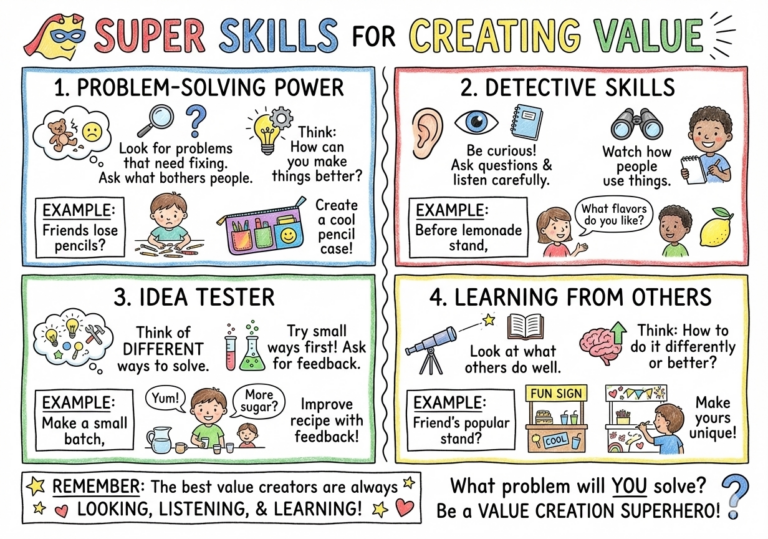
Here are some super skills you can develop to become a value creation superhero!
Example: Notice that your friends always lose their pencils. Can you create a cool pencil case that helps them keep track of their stuff?

Example: Before making lemonade to sell, ask your neighbors what flavors they enjoy most.

Example: Make a small batch of your new lemonade flavor and let your family taste it first. Use their feedback to improve your recipe.

Example: If your friend’s lemonade stand is popular, what makes it special? Maybe they use fun cups or have a catchy sign. How can you make your stand unique?

Remember: The best value creators are always looking, listening, and learning. They solve problems in new and exciting ways that make people happy!
Nine-year-old Sophie loved solving puzzles, but the biggest puzzle at Roosevelt Elementary wasn’t in any textbook. It happened every time it rained.
SPLAT! SPLAT! SPLAT!
Sophie watched the raindrops hit the classroom window as Mrs. Martinez announced, “Indoor recess today, everyone!”
A collective groan filled the room. Sophie looked around and saw the same thing that happened every rainy day: kids slumped in their chairs, looking absolutely miserable.
“I’m so bored,” complained her friend Tyler, slumping over his desk.
“There’s nothing fun to do inside,” added Emma, staring at the ceiling.
Sophie’s mind started working like a detective’s. This was definitely a problem that needed fixing. While other kids complained, Sophie pulled out her notebook and wrote: “PROBLEM: Kids are super bored during indoor recess.”
But Sophie didn’t just want to complain—she wanted to solve it.
During indoor recess, instead of being bored herself, Sophie became a detective. She started asking questions and really listening to the answers.
“Tyler, what do you wish we could do when it rains?” she asked.
“I don’t know… something fun? Maybe games that aren’t boring?”
Sophie wrote that down. Then she asked Emma, “What makes you happy when you’re stuck inside at home?”
“Building pillow forts with my little sister, or making up stories with my action figures,” Emma replied.
Sophie kept asking questions. She discovered that Jake loved drawing comics, Maria enjoyed building with blocks, and Alex liked brain teasers. The more she listened, the clearer the picture became.
“So people like different things,” Sophie murmured, studying her notes. “Some like building, some like stories, some like puzzles…”
That afternoon, Sophie had an idea. But she remembered what her dad always said about his work: “Test small before you go big, kiddo.”
Sophie decided to try out her idea in a tiny way first. The next rainy day, she brought a small box of craft supplies from home—just paper, colored pencils, and pipe cleaners.
“Want to make something?” she offered to a few kids sitting nearby.
Within minutes, Tyler was creating a paper airplane design contest, Emma was making pipe cleaner animals, and Jake was drawing a comic about super-powered pencils.
“This is actually fun!” said Tyler, launching his newest airplane design.
Sophie watched carefully and took notes on what worked and what didn’t. The craft supplies were popular, but they ran out quickly. Some kids wanted to build bigger things. Others wanted games they could play together.
“I need more ideas,” Sophie thought.
That’s when Sophie decided to become a learning detective. She started paying attention to what worked well in other places.
She noticed that the library had cozy reading corners with beanbags. The art room had stations for different activities. At her cousin’s school, they had something called “choice time” where kids could pick from several different activity areas.
“What if…” Sophie wondered, “I could bring some of these good ideas together?”
Sophie also remembered the amazing activity boxes her Aunt Lisa used when she babysat—each box had everything needed for a different kind of fun.
Now Sophie had a plan that combined everything she’d learned.
She spent the weekend creating “Rainy Day Activity Stations.” Using shoeboxes from home, she made:
A “Building Zone” box with paper cups, blocks, and construction challenges
A “Story Station” with puppets, story prompts, and comic templates
A “Puzzle Power” box with brain teasers and mini-games
A “Create & Make” station with rotating craft projects
But before bringing everything to school, Sophie tested her ideas one more time. She invited her neighbor friends over on a Saturday and set up her activity stations.
“Try these out and tell me honestly what you think,” she said.
Her friend Marcus loved the building challenges but thought the story station needed more props. Her neighbor Zoe suggested adding a quiet zone for kids who just wanted to read or think.
Sophie took notes on every suggestion and improved her stations.
On Monday morning, Sophie nervously approached Mrs. Martinez before class.
“I’ve been working on a solution for indoor recess,” Sophie explained, showing her teacher the organized activity boxes. “I noticed kids get really bored when it rains, so I asked them what they like to do, tested some ideas, and learned from what works in other places.”
Mrs. Martinez’s eyes widened as she examined each carefully planned station. “Sophie, this is incredible! You’ve really thought this through. Let’s try it today.”
When the afternoon rain started and Mrs. Martinez announced indoor recess, something magical happened. Instead of groans, there were excited whispers as Sophie unveiled her Rainy Day Activity Stations.
Kids flocked to different areas based on what they enjoyed. Tyler immediately headed to the Building Zone, Emma grabbed puppets from the Story Station, and Jake discovered the comic templates. Even quiet kids found cozy spots to read or work on puzzles.
“Sophie, you’re a genius!” said Emma, making her puppet dance. “How did you know exactly what we wanted?”
“I asked, I watched, I tested, and I learned from other smart people,” Sophie replied with a big grin.
Mrs. Martinez was amazed. “Sophie, you’ve solved a problem that we’ve struggled with for years. These stations are exactly what our classroom needed.”
Word spread quickly. Other teachers asked Sophie to help them create activity stations for their classrooms. The principal invited Sophie to share her “problem-solving process” with other student leaders.
“You used real detective skills,” her dad said proudly that evening. “You spotted a problem, investigated what people needed, tested your solutions, and learned from the best ideas around you.”
Sophie nodded, already thinking about the next problem she’d noticed: the long lunch line that made kids late to recess.
“Detective Sophie is on the case,” she whispered to herself, pulling out her notebook to start her investigation.
As she drifted off to sleep, Sophie could hear rain starting to fall again. But instead of feeling sorry for her classmates, she felt excited. Tomorrow’s indoor recess was going to be the best one yet.
And somewhere in her dreams, she was already solving the next puzzle, using her super skills to make school a little bit better for everyone.
Verse 1:
Got my problem-solving cape on tight
Detective hat, yeah it feels just right
I’m on a mission, to make things great
Creating value, that’s my fate
Pre-Chorus:
Listen up, watch and learn
Super skills, now it’s your turn
Chorus:
I’m a Value Creation Superhero
Solving problems, from high to zero
Testing ideas, making things better
Learning from others, I’m a real go-getter
Oh yeah, oh yeah
Value Creation Superhero, that’s me!
Verse 2:
Curiosity is my secret power
Asking questions every minute, every hour
Try it small before you go big
Feedback’s gold, don’t you dig?
(Pre-Chorus)
(Chorus)
Bridge:
Look around, what needs fixing?
Use your skills, start mixing
A dash of this, a sprinkle of that
Value creation, where it’s at!
(Chorus)
Outro:
So put on your cape, and join the crew
Value Creation Superhero, it could be you!