


We’ve been taught that good thinking means controlling our emotions – that logic and feelings are opposites.
But here’s what the research actually shows: our most effective thinking happens when emotions and logic work together, not when we suppress one for the other.
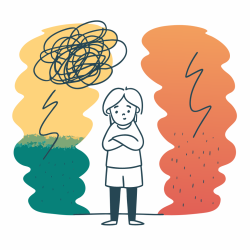
When your 8-year-old gets frustrated with fractions and throws their pencil, your instinct might be to say “Calm down and think logically.”
But that actually creates what psychologists call “cognitive dissonance” – internal conflict that makes thinking harder, not easier.
Instead, try this 3-step process:
Example:
Child: “I hate writing! It’s stupid!”
❌ Old way: “Stop being dramatic and just write your paragraph.”
✅ New way: “Writing feels really hard right now. Help me understand what part is bothering you most… Okay, so forming your thoughts into sentences feels overwhelming. Let’s try talking through your ideas first, then we’ll capture them on paper.”
Children who learn this approach don’t just become better problem-solvers – they develop emotional intelligence AND critical thinking skills simultaneously. They learn that their feelings contain valuable information, and that logic helps them act on that information wisely.
Your homeschooled child will enter adulthood knowing how to think clearly under pressure, make better decisions, and solve complex problems – because they never learned that emotions were the enemy of good thinking.
Try This Week: Next time your child gets emotionally stuck on a learning challenge, resist the urge to dismiss the emotion. Instead, get curious about it together, then problem-solve as a team.
Marcus sat on his bedroom floor, surrounded by half-packed boxes, feeling miserable. Tomorrow they’d leave this house forever for the new one across town. He knew he should be excited—the new house had a bigger room, a better school district, and was closer to Dad’s job. It made perfect sense.
So why did his chest feel so heavy?
“I’m being stupid,” he told himself, taping up another box. “The new house is better. I should be happy about this.”
But the sadness kept washing over him anyway, making him feel guilty for not appreciating how much better everything would be.
Mom found him sitting there, staring at his empty walls.
“You look like you’re carrying the weight of the world,” she said, settling down beside him.
“I’m trying not to be sad about moving,” Marcus said, forcing a smile. “The new house is obviously better. Better room, better neighborhood, better everything. I know I should be logical about this.”
“Should be logical instead of sad?” Mom asked gently. “Marcus, what if being sad IS logical?”
Marcus looked confused. “How can sadness be logical? Sad is the opposite of logical.”
“Well, let me ask you something. What exactly are you sad about?”
Marcus thought for a moment. “I’m sad about leaving my treehouse. And the way the morning light comes through my window here. And how I know exactly which floorboard creaks when I sneak to the kitchen at night.” His voice got quieter. “And that Mr. Peterson next door waves at me every morning when I wait for the bus.”
“So you’re sad about losing things that matter to you?”
“Yeah, but—”
“Marcus, listen carefully. Your sadness isn’t fighting against good thinking. It’s your heart’s way of saying ‘Pay attention! These things are precious to me!’ And that’s incredibly smart information.”
Something shifted in Marcus’s understanding. “You mean… my sad feelings are telling me what I care about?”
“Exactly. Your emotions are like a really wise advisor pointing out what’s valuable to you. And your logical mind is like a brilliant planner who can figure out how to honor those valuable things, even in a new place.”
Marcus felt his chest loosen slightly. “So being sad doesn’t mean I’m not being logical?”
“Think about it this way,” Mom continued. “Your sadness is telling you that morning light, quiet spaces, friendly neighbors, and knowing your environment well are all important to you. Now your logical mind can work with that information. What could we do?”
For the first time in days, Marcus felt his mind clear. “Well… I could ask if we can find a good tree for a new treehouse. And maybe we could drive by here sometimes to wave at Mr. Peterson. And I could explore the new house really carefully so I learn all its sounds and hiding spots.”
“How does that feel?”
“Like… like I’m honoring what I love instead of just leaving it behind,” Marcus said, surprised. “Like I’m taking the good stuff with me.”
“When your feelings and your thinking work together, you don’t have to choose between caring and being smart,” Mom said. “You get to be both.”
The next morning, as the moving truck pulled up, Marcus felt sad AND excited. The sadness told him how much this place had meant to him, and his planning mind had figured out ways to carry that meaning forward.
He hugged Mr. Peterson goodbye and promised to visit. He took a photo of how the morning light looked in his old room. And he asked Dad to help him pick out the perfect tree in their new yard.
“I thought I had to choose between missing the old house and being happy about the new one,” Marcus told Mom as they drove to their new home. “But I can actually do both?”
“Your feelings don’t disappear when you think clearly,” Mom said. “They become your thinking partner. Your sadness helped you identify what you want to recreate in your new life.”
That evening, as Marcus explored every corner of his new house, learning which stairs creaked and where the best hiding spots were, he realized something important. He wasn’t broken for feeling sad about leaving good things behind. That sadness was actually his inner wisdom, making sure he didn’t forget what mattered most.
And his logical mind was the perfect partner to help him build those meaningful things into his new life.
From then on, whenever Marcus felt a strong emotion about a change or challenge, he asked himself: “What is this feeling trying to protect or preserve?” and “How can I be smart about honoring that?”
It turned out that being sad AND being logical at the same time didn’t cancel each other out.
They made him incredibly wise.