If you’re a parent using AI to help with your children’s education, you’ve probably noticed something strange. Despite having access to tools that can generate lesson plans in seconds, create personalized worksheets, and answer any question imaginable, you’re not working less. In fact, you might be working more than ever.
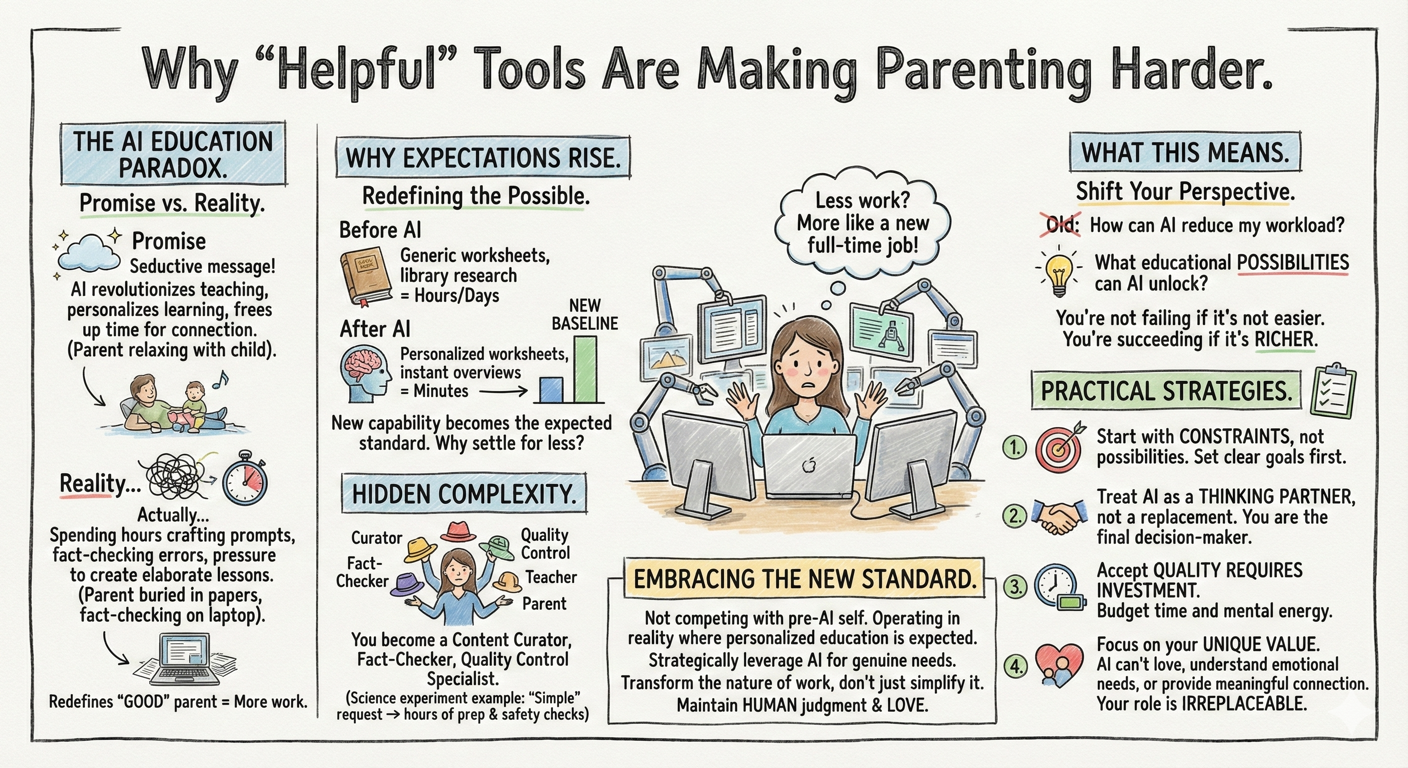
Welcome to the AI education paradox: tools designed to make parenting easier are actually raising the bar for what we think we should accomplish with our children.
The marketing message is seductive. AI will revolutionize how we teach our kids. It will personalize their learning, adapt to their pace, and free us from the drudgery of curriculum planning. We’ll finally have time to focus on what really matters: connecting with our children and nurturing their growth.
But here’s what actually happens: You spend an hour crafting the perfect prompt to generate math problems for your 8-year-old. You fact-check every “historical fact” the AI provides because you’ve caught it making mistakes. You feel pressure to create elaborate science experiments because AI made it seem so simple to design them. Instead of reducing your workload, AI has fundamentally redefined what’s expected of a “good” parent.
This isn’t a failure of the technology or your ability to use it correctly. It’s the natural result of how powerful tools reshape our world.
There’s a profound insight hidden in how we interact with transformative technologies: they don’t just optimize the old way of doing things; they fundamentally redefine what’s possible. And because they redefine what’s possible, they also redefine what’s expected.
Before AI, creating 20 different math worksheets tailored to your child’s specific learning gaps would have taken days. Now it takes 20 minutes. But instead of saving you time, this capability becomes the new baseline. Why would you settle for generic worksheets when personalized ones are so “easy” to create?
Before AI, researching the causes of the Civil War for your teenager’s history project meant trips to the library and hours of reading. Now AI can provide a comprehensive overview in minutes. But this doesn’t reduce the work—it raises the standard for what constitutes thorough research.
The tool’s purpose isn’t to make parenting effortless. It’s to empower you to tackle more complex educational challenges and achieve more ambitious learning goals for your children.
Every AI-generated lesson plan requires human judgment to evaluate its accuracy and appropriateness. Every AI-suggested activity needs to be vetted for safety and educational value. Every AI-created assessment must be reviewed to ensure it aligns with your child’s actual needs.
You’ve unknowingly become a content curator, a fact-checker, and a quality control specialist—all while still being the teacher, motivator, and parent you always were.
Consider the parent who asks AI to create a week of science experiments for their curious 6-year-old. AI obliges with creative, engaging activities. But now that parent must research the safety of each experiment, gather specialized materials, understand the underlying scientific principles well enough to guide their child, and prepare for questions that might arise. The “simple” request has spawned hours of additional work.
Understanding this paradox is liberating because it helps you set realistic expectations. AI isn’t supposed to make you a more efficient version of your old parenting self. It’s enabling you to become a different kind of parent entirely—one who can provide educational experiences that were previously impossible.
Instead of asking “How can AI reduce my workload?” ask “What educational possibilities can AI help me unlock for my children?”
This shift in perspective changes everything. You’re not failing if AI doesn’t make your life easier. You’re succeeding if it helps you provide richer, more personalized learning experiences for your kids.
Start with constraints, not possibilities. Before exploring what AI can do, decide what you actually want to accomplish. Do you want to strengthen your child’s weak areas, enrich their interests, or expose them to new subjects? Having clear goals prevents you from feeling overwhelmed by AI’s endless capabilities.
Treat AI as a thinking partner, not a replacement for thinking. Use it to brainstorm ideas, explore different approaches, and generate raw materials. But maintain your role as the final decision-maker about what serves your child’s needs.
Accept that quality requires investment. The best AI-generated educational content comes from thoughtful prompts, careful evaluation, and ongoing refinement. This takes time and mental energy. Budget for this investment rather than expecting instant results.
Focus on your unique value as a parent. AI can generate content, but it can’t love your child, understand their emotional needs, or provide the encouragement and connection that makes learning meaningful. Your irreplaceable role is knowing your child deeply and using that knowledge to guide their educational journey.
The parents who thrive with AI tools understand that they’re not competing with their pre-AI selves. They’re operating in a new reality where personalized, adaptive education is not just possible but increasingly expected.
This doesn’t mean you must use every AI capability or create elaborate educational experiences for every learning moment. It means thoughtfully choosing when and how to leverage AI’s power to serve your children’s genuine needs.
The goal isn’t to do everything AI makes possible. It’s to use AI strategically to tackle the educational challenges that matter most to your family, while accepting that this enhanced capability comes with enhanced responsibility.
In the end, the AI education paradox reflects a deeper truth about powerful tools: they don’t simplify our lives as much as they transform the nature of our work. By understanding and embracing this transformation, you can harness AI’s genuine benefits while maintaining the human judgment, wisdom, and love that remain irreplaceable in your children’s education.
The question isn’t whether AI will make parenting easier. It’s whether you’re ready to become the kind of parent who can guide children in a world where AI collaboration is the new normal.