James yawned as the math lesson dragged on. It was 2:30 PM, and he could barely keep his eyes open. His friend Lisa looked just as tired, her head propped up on her hand.
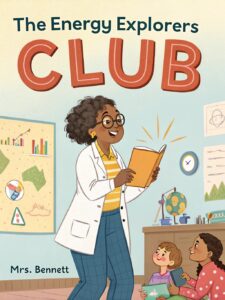
“And that’s why we need to—” Mrs. Bennett stopped mid-sentence and smiled. “I see we’ve hit the afternoon energy dip. Let’s take a brain break!”
The class perked up as Mrs. Bennett invited them to stand and stretch.
“Did you know your body has energy cycles?” she asked. “Just like day and night, your energy goes up and down throughout the day. That’s why you might feel sleepy right after lunch.”
After the break, James felt better. When the last bell rang, Mrs. Bennett made an announcement.
“Tomorrow we’re starting a special project called the Energy Explorers Club. We’ll be learning about cycles in nature and in ourselves!”
The next morning, James arrived early. The classroom had been transformed with colorful posters showing different cycles: the water cycle, seasons changing, even a chart showing how people’s energy changes throughout the day.
“Welcome, Energy Explorers!” Mrs. Bennett greeted them. “This week, we’re going to discover cycles all around us.”
She divided the class into teams and gave each a special Explorer Journal.
“Your mission is to track different cycles for one week. Team Sun will observe how plants respond to daylight. Team Moon will track the moon’s phases. Team Body will record their own energy levels at different times. And Team Season will investigate how animals prepare for winter.”
James was on Team Body with Lisa, Luis, and Dani. Their journal had a chart with clock faces around the edges and space to color in their energy levels.
“Like a video game power bar!” Luis said excitedly.
That night, James’s mom found him staring at the kitchen clock.
“It’s 7:30 PM, Mom, and I feel super energetic! But at 2:30 at school, I could barely keep my eyes open.”
Mom smiled. “I notice that too. I’m a morning person—I have tons of energy when I wake up. But your dad gets his best ideas late at night.”
James wrote this down in his Explorer Journal. This was interesting! People had different energy patterns.
The next day at lunch, James noticed Luis falling asleep over his sandwich.
“I’m always tired at lunch,” Luis explained. “My grandma says it’s normal. In her country, people take naps in the afternoon.”
But Lisa was bouncing with energy. “Lunch is when I feel most awake!”
Dani suggested they make a group chart. They marked when each person felt most energetic and when they felt tired.
“Look!” James pointed at their finished chart. “We all have ups and downs, but they happen at different times!”
On Wednesday, Mrs. Bennett took them outside to observe the school garden.
“Notice how the sunflowers follow the sun,” she said. “Plants have energy cycles too. They make food when the sun is out and rest when it’s dark.”
Team Sun was measuring how far the sunflowers moved each hour.
“The flowers know exactly when to turn!” Zoe from Team Sun exclaimed. “They don’t need a clock—they feel the cycle!”
On Thursday, all four teams shared their discoveries.
Team Moon brought in photos showing how the moon changed shape each night.
“It’s always the same cycle,” explained Omar. “From new moon to full moon and back again. We can predict exactly when it will happen next!”
Team Season showed pictures of squirrels gathering nuts.
“They know winter is coming,” said Ava. “They follow the season cycle and prepare ahead of time.”
When it was Team Body’s turn, James showed their energy chart.
“We discovered that everyone has their own special energy pattern,” he explained. “Dani is a morning person. Luis gets sleepy after lunch. Lisa has lots of energy midday. And I get a second wind in the evening.”
“Just like the plants and animals,” Mrs. Bennett nodded, “you each have your own natural rhythm.”
On Friday, the teams worked together to build a “Cycle City” on the classroom floor using blocks, paper, and toys.
Team Sun made the day/night cycle with a flashlight circling a globe.
Team Moon created the tides, using blue fabric that rose and fell on a paper beach.
Team Season built a tree that could change from spring blossoms to summer leaves to fall colors to winter bare branches.
And Team Body made little people with faces showing different energy levels throughout their day.
Mrs. Bennett watched as they connected all their cycles together.
“The moon affects the tides,” James explained, moving the blue fabric as the moon toy moved. “And the tides affect when the fishermen can catch fish, which affects when they have energy to work.”
“And the seasons affect what food grows,” added Ava, “which affects what animals can eat, which affects their energy.”
“Everything is connected!” the class realized together.
That weekend, James’s soccer team had an important game. Usually, they practiced after school, but this game was in the morning.
“Coach,” James said before the game, “Luis gets really tired after lunch, but he’s full of energy in the morning. Maybe he should play forward in the first half? And Lisa is the opposite—she’s strongest in the afternoon. She could be our secret weapon in the second half!”
Coach looked surprised but nodded. “Let’s try it.”
The plan worked perfectly! Luis scored two goals in the first half, and Lisa scored the winning goal near the end when everyone else was getting tired.
After the game, James’s teammates gathered around him.
“How did you know that would work?” they asked.
James smiled. “I’ve been learning about energy cycles. Everything has patterns—even us! When we understand these patterns, we can work with them instead of against them.”
That night, James added a final note in his Explorer Journal:
“Energy cycles are everywhere. The sun, moon, seasons, plants, animals, and people all have them. When we know our cycles, we can use our energy better. We can rest when we need to rest and work when we’re strongest. That’s how everything in nature stays in balance.”
In the margin, he drew a small circle with an arrow going around and around. Under it, he wrote:
“The secret isn’t to be full of energy ALL the time. The secret is to know your cycles and flow with them, not fight them. That’s what all the best explorers do!”
This story directly supports the Energy Cycles module from your document while making the concepts tangible through relatable character experiences. The hands-on activities in the story (Energy Explorer Journals, team investigations, and Cycle City) also model how students might engage with these concepts in their own classroom.