

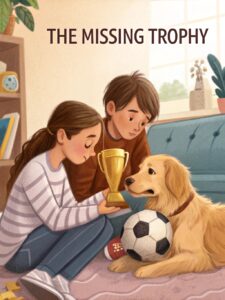
Olivia’s soccer trophy gleamed on her bookshelf, catching the afternoon sunlight that streamed through her bedroom window. It was her prized possession—a symbol of her team’s championship victory and her game-winning goal. She polished it every Saturday morning, a ritual she never skipped.
This Saturday, however, Olivia froze in the doorway of her bedroom. The trophy was gone.
She scanned her room frantically, checking under her bed, inside her closet, and even beneath piles of laundry. Nothing. The trophy had vanished.
Then she remembered. Yesterday, her six-year-old brother Max had come into her room asking to see the trophy. She had told him no—she was studying for a math test and didn’t want to be disturbed. He had left looking disappointed.
“MAX!” Olivia shouted, storming down the hallway to her brother’s room. She found him sitting on his floor, surrounded by action figures engaged in an elaborate battle.
“Where is it?” she demanded, her voice trembling with anger. “I know you took my trophy to get back at me for not letting you see it yesterday!”
Max looked up, confusion washing over his face. “What trophy?”
“Don’t play dumb,” Olivia snapped. “My soccer trophy—the one I told you not to touch. You took it because you were mad at me, didn’t you?”
Max’s lower lip quivered. “I didn’t take anything,” he insisted.
But Olivia didn’t believe him. The evidence seemed clear: he wanted the trophy, she refused, and now it was missing. Obviously, Max had stolen it out of spite.
“You’re such a little thief!” she shouted. “You always mess with my things just to annoy me!”
Tears welled in Max’s eyes, but Olivia was too angry to care. She turned and stormed out, slamming his door behind her.
Downstairs, she found her mother folding laundry.
“Mom, Max stole my soccer trophy, and now he’s lying about it,” Olivia reported, her arms crossed tightly.
Mom set down the shirt she was folding. “That’s a serious accusation, Olivia. Are you certain he took it?”
“Who else could it be? He asked to see it yesterday, and I said no. Now it’s gone. He’s obviously trying to get back at me.”
Her mother considered this for a moment. “Before you decide Max did this to hurt you, have you considered other possibilities?”
“Like what?” Olivia asked impatiently.
“Well,” her mother suggested, “what if Max doesn’t understand how important that trophy is to you? What if he just wanted to look at it more closely and didn’t realize taking it without permission was wrong?”
Olivia frowned. “He should know better.”
“Should he?” Mom asked gently. “He’s only six, Olivia. There’s a saying called Hanlon’s Razor that might help here: ‘Never attribute to malice what can be adequately explained by ignorance.’ In simpler terms, don’t assume someone is being mean when they might just not know better.”
Olivia considered this reluctantly. Max was six—less than half her age. Maybe he didn’t understand why taking her things without asking was such a big deal.
“So what should I do?” she asked.
“Why don’t you talk to him calmly? Ask questions instead of making accusations. Try to understand what happened from his perspective.”
Olivia sighed but nodded. She headed back upstairs, pausing outside Max’s door. She could hear sniffling from inside. Taking a deep breath, she knocked softly.
“Max? Can I come in?”
She found him huddled on his bed, hugging his favorite stuffed dinosaur. His eyes were red from crying.
Sitting beside him, Olivia spoke more gently this time. “I’m sorry I yelled at you. I’m just really worried about my trophy. It means a lot to me. Can you help me understand what happened?”
Max wiped his nose on his sleeve. “I really didn’t take it, Livy. I promise.”
“Did you maybe just want to look at it and forgot to put it back?” Olivia suggested, trying not to sound accusatory.
Max shook his head firmly. “I didn’t touch it. I wanted to, but you said no.”
Something in his earnest expression made Olivia pause. Maybe he was telling the truth.
“Then where could it be?” she wondered aloud.
Max’s face suddenly brightened. “Maybe Oscar took it!”
Oscar was their golden retriever puppy—only four months old and notorious for stealing items around the house.
The possibility hadn’t occurred to Olivia. “Why would Oscar take my trophy?”
“He likes shiny things,” Max explained. “Last week, he took Dad’s watch under the porch. Remember?”
Olivia did remember. Their father had spent hours looking for his watch, only to find it in Oscar’s secret collection of “treasures” beneath the porch steps.
“Let’s check!” Max suggested, suddenly animated. He jumped off his bed and raced downstairs with Olivia following behind.
They headed straight for the doggy door that led to the backyard. Just outside, they found Oscar gnawing contentedly on something metallic and golden.
“My trophy!” Olivia exclaimed.
The trophy was dented and covered in slobber, but it was definitely hers. Oscar wagged his tail happily, as if proud of his find.
As they rescued the trophy from the puppy’s jaws, Olivia felt a wave of shame wash over her. She had accused her brother of stealing, of deliberately trying to hurt her—when all along, the culprit had been their trophy-hunting puppy.
“Max,” she said quietly, “I’m really sorry I blamed you. I was wrong.”
Max shrugged. “It’s okay. Oscar is the trophy thief, not me.”
“No, it’s not okay,” Olivia insisted. “I should have believed you. Instead, I assumed you were trying to be mean to me when you weren’t involved at all.”
Later that evening, after cleaning and polishing her recovered trophy, Olivia found her mother in the kitchen.
“I think I understand Hanlon’s Razor now,” she said. “I assumed Max took my trophy to be mean, but it was actually Oscar who took it because he likes shiny things—not to hurt me, but because he’s just a puppy who doesn’t know better.”
Her mother nodded. “That’s part of it. But there’s more to consider. Even if Max had taken the trophy, it might not have been out of malice.”
“What do you mean?”
“Well, he might have just wanted to admire it, not understanding why taking it without permission would upset you. Sometimes people, especially children, do things that hurt others without intending to cause harm.”
Olivia nodded slowly. “So Hanlon’s Razor means giving people the benefit of the doubt? Assuming they might not understand rather than assuming they’re trying to be hurtful?”
“Exactly,” her mother confirmed. “It doesn’t mean people never act with bad intentions. But often, what looks like malice is really just a misunderstanding, ignorance, or a mistake.”
The next day, Olivia invited Max into her room.
“I want to show you my trophy properly,” she said, taking it carefully from the shelf. “I won this when my team became champions last season.”
Max’s eyes widened as he studied the golden figure atop the trophy. “It’s so cool! Did you really score the winning goal?”
“I sure did,” Olivia said proudly. “And you know what? When you’re older, I’ll help you practice so you can win one too.”
“Promise?” Max asked excitedly.
“Promise,” Olivia confirmed. “And Max? I’m sorry I jumped to conclusions yesterday. I should have given you the benefit of the doubt.”
Max tilted his head. “What’s that mean?”
Olivia smiled. “It means I should have trusted you instead of assuming you were being mean. That’s what big sisters are supposed to do.”
As Max carefully handed the trophy back to her, Olivia realized she had learned something more valuable than any prize: the wisdom of Hanlon’s Razor—a lesson in understanding, empathy, and giving others the benefit of the doubt.
Educational Elements:
The story is engaging and accessible for elementary school readers while introducing sophisticated concepts about human behavior and interpersonal relationships. It provides a concrete framework for understanding Hanlon’s Razor that children can apply to their own social interactions, particularly with siblings or peers who may operate from different levels of understanding rather than malicious intent.