

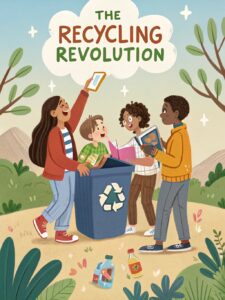
The student council meeting at Lincoln Middle School was not going well. Principal Garcia had just announced that the school’s recycling program would be discontinued due to budget cuts.
“But we can’t just stop recycling!” exclaimed Zoe, the seventh-grade representative. “It took years to get everyone on board with separating trash correctly.”
“I understand your concern,” Principal Garcia replied, “but the company that collects our recycling is raising their prices, and the school simply can’t afford it anymore.”
As the meeting ended, Zoe and her friend Marcus lingered in the classroom, frustrated by the news.
“There has to be a solution,” Marcus said, tapping his pencil rhythmically against the desk. “Maybe we could hold a fundraiser?”
“We’d need to raise money every month forever,” Zoe sighed. “That’s not sustainable.”
Their science teacher, Ms. Patel, overheard their conversation as she organized materials for her next class.
“Have you two ever heard of the SCAMPER method?” she asked, approaching their desks.
Zoe and Marcus exchanged confused looks.
“It’s a creative problem-solving technique,” Ms. Patel explained. “Each letter stands for a different way to think about a problem. S is for Substitute, C for Combine, A for Adapt, M for Modify or Magnify or Minimize, P for Put to another use, E for Eliminate, and R for Reverse or Rearrange.”
“That sounds complicated,” Marcus said skeptically.
“Not really,” Ms. Patel assured them. “It’s just a structured way to brainstorm ideas. Why don’t you try applying it to your recycling problem? Start with ‘Substitute.’ What could you substitute in the current recycling system?”
Marcus thought for a moment. “Well, we could substitute the expensive recycling company with… something else? But what?”
“Keep going,” Ms. Patel encouraged. “The first ideas don’t have to be perfect. That’s why there are seven techniques.”
The next day, Zoe and Marcus invited a few classmates to join them in the library during lunch. They explained the SCAMPER method and wrote each letter on a separate poster board.
“Let’s start with Substitute,” Zoe said. “What can we substitute for the expensive recycling service?”
“Another recycling company?” suggested Alex.
“Student volunteers to take the recycling instead of a company?” offered Jameela.
“Community members who already go to the recycling center?” added Sam.
They wrote down every idea, no matter how impractical it seemed.
“Now let’s try Combine,” Marcus said. “What could we combine with our current recycling program to make it work better?”
“We could combine recycling with the school store,” suggested Alex. “Maybe offer discounts to students who bring in recyclables?”
“Or combine it with art class,” Jameela added. “Use some recyclables for projects instead of sending them all away.”
Moving through the SCAMPER techniques, the ideas started flowing more freely:
For Adapt, they brainstormed ways to modify the current system: “What if we had bigger collection bins but fewer pickups?” “What if we focused only on the most valuable recyclables like aluminum?”
For Modify/Magnify/Minimize, they considered scaling aspects up or down: “Could we expand to collect recyclables from neighborhood homes?” “Should we shrink the program to just paper since we use so much of it?”
For Put to another use, they thought about different purposes for the recyclables: “Could we use plastic bottles to make greenhouse planters for science class?” “What about using cardboard for set designs in the drama department?”
For Eliminate, they identified what could be removed: “Do we need separate bins for every type of recyclable?” “Could we eliminate disposable water bottles by encouraging refillable ones?”
For Reverse/Rearrange, they flipped the problem around: “Instead of paying someone to take our recycling, could we sell it to someone?” “What if teachers brought recyclables to school instead of generating them here?”
After an hour of brainstorming, their poster boards were covered with ideas. Some were clearly impractical, but others showed promise.
“This SCAMPER thing actually works,” Sam said, looking impressed. “We have way more ideas than I thought we would.”
“But which one do we choose?” asked Alex.
Zoe studied the boards. “I don’t think we need to pick just one. Maybe the solution is combining several of these ideas.”
Over the next few days, the group refined their plan. When they finally presented it to Principal Garcia and the school board, they called it “The Recycling Revolution.”
“Our solution has three parts,” Zoe explained confidently. “First, we’ll minimize what needs to be recycled by implementing a school-wide campaign to reduce waste, especially single-use plastics.”
Marcus continued, “Second, we’ll put recyclables to another use through our new ‘Creative Reuse Center.’ Art classes, STEM projects, and drama productions can use many of the materials we currently recycle.”
“And finally,” Jameela added, “we’ll substitute the commercial recycling service with a partnership with Green Future Recycling. They’re a non-profit that will pick up our remaining recyclables for free because they can use them for their job training program.”
Principal Garcia looked genuinely impressed. “This is remarkably thorough. How did you come up with such a comprehensive plan?”
“We used SCAMPER,” Zoe explained, showing the principal their poster boards. “It helped us see the problem from different angles instead of just accepting the first solution that came to mind.”
Two months later, the Recycling Revolution was in full swing. The Creative Reuse Center had become a popular resource for projects across all subjects. The cafeteria had reduced its waste by 30% through simple changes like eliminating straws and using reusable trays. And Green Future Recycling had begun weekly pickups of the remaining materials, providing valuable job training for their participants.
“You know what amazes me the most?” Marcus said to Zoe as they organized the Reuse Center after school. “We didn’t just save the recycling program—we made it better.”
“That’s what Ms. Patel said would happen,” Zoe replied. “SCAMPER doesn’t just help you solve problems—it helps you find opportunities within those problems.”
Word about Lincoln Middle School’s innovative approach spread quickly. Soon, other schools in the district were asking how they could implement similar programs.
At the district’s teacher conference, Ms. Patel gave a presentation about using SCAMPER in the classroom, using the Recycling Revolution as her prime example.
“The most valuable lesson these students learned wasn’t about recycling,” she told the assembled teachers. “It was about how systematic creativity can transform challenges into opportunities. By applying the SCAMPER techniques, they discovered that innovation isn’t just about random flashes of brilliance—it’s about looking at problems from multiple perspectives and being willing to experiment with new combinations of ideas.”
Back at Lincoln Middle, the student council had started using SCAMPER for all sorts of challenges: improving the lunch line efficiency, making school events more inclusive, and redesigning the outdoor seating area.
“The amazing thing about SCAMPER,” Zoe explained to a group of fifth-graders touring the school, “is that it works for almost any problem. Once you learn the seven techniques, you’ll never look at challenges the same way again.”
As she watched the younger students’ eyes light up with understanding, Zoe realized that SCAMPER had changed more than just the recycling program—it had changed how she approached every obstacle in her life, turning problems into opportunities for creative solutions.
The story encourages valuable educational applications including:
The intermediate reading level includes some technical vocabulary related to the SCAMPER method but maintains accessibility through a familiar school setting, straightforward dialogue, and concrete examples of each technique in action.