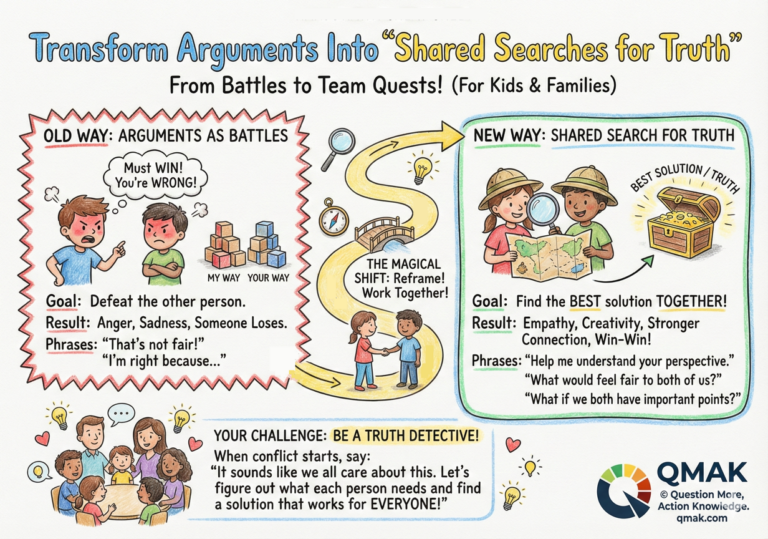

Most of us grew up thinking arguments were battles to be won. Someone’s right, someone’s wrong, and the goal is to prove your point. We unconsciously pass this mindset to our kids, teaching them that disagreements are competitions where one person comes out on top.
But what if everything we’ve been taught about arguments is backwards?
Here’s a radical reframe that will transform your family dynamics: Arguments aren’t clashes to be won – they’re shared searches for truth. When we approach disagreements this way, something magical happens. Instead of trying to defeat each other, we’re working together to find the best solution.
This isn’t just feel-good philosophy. It’s a practical approach that builds critical thinking, collaboration skills, and emotional intelligence all at once.
Think about the last sibling argument in your house. Maybe it was about whose turn it is to choose the movie, or who gets the bigger piece of cake.
Traditional approach? You either pick a winner or enforce “fairness” through rules.
But when you reframe arguments as collaborative problem-solving, you’re teaching your children a life skill that will serve them in future relationships, careers, and their own parenting.
Instead of teaching kids to say “You’re wrong,” teach them to say “Help me understand your perspective.“
Instead of “That’s not fair,” try “What would feel fair to both of us?“
Instead of “I’m right because…” encourage “What if we both have important points?“
Example:
Two siblings fighting over screen time:
❌ Old approach: “Stop arguing. Sarah, you had your turn. Now it’s Jake’s turn.”
✅ New approach: “I hear two people who both want something important. Sarah, what do you need right now? Jake, what’s important to you? How might we solve this so you both feel good about the solution?”
When children learn to approach conflicts this way, several things happen:
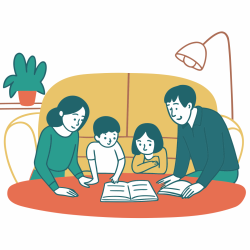
Start by modeling this yourself. The next time you disagree with your spouse in front of the kids, let them see you say something like: “I have a different perspective on this. Help me understand what you’re thinking, and then I’d love to share my view too.“
When your children argue, resist the urge to immediately solve the problem for them. Instead, become a facilitator: “It sounds like you both want something important here. Let’s figure out what that is.“
Children who learn this approach don’t just become better family members – they become adults who can navigate workplace disagreements, maintain healthy marriages, and raise the next generation with even stronger collaboration skills.
They enter the world knowing that different perspectives aren’t threats to be defeated, but resources to be explored. They understand that the best solutions often come from combining multiple viewpoints, not from one person imposing their will on another.
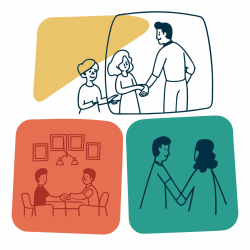
The next time conflict erupts in your house, try this phrase: “It sounds like we all care about this, but we see it differently. Let’s figure out what each person needs, and then see if we can find a solution that works for everyone.“
You might be amazed at the creative solutions your children come up with when they’re working together instead of against each other.
The Pizza Night Experiment
Friday nights at the Marino house always started the same way: with the Great Pizza Debate.
“Meat lovers!” Dad announced, waving the pizza menu. “Pepperoni, sausage, bacon—real food for real people.”
“David, that’s terrible for us,” Mom protested. “We need vegetables. Green peppers, mushrooms, tomatoes. Our bodies need nutrition.”
Ten-year-old Bianca made a face. “Vegetables are gross! Just cheese pizza. Why does everything have to be complicated?”
Eight-year-old Sam bounced in his chair. “Hawaiian! Pineapple and ham! It’s like a tropical vacation in your mouth!”
The usual pattern followed: everyone argued their case louder, Dad eventually ordered three different pizzas (which cost a fortune), and someone always ended up disappointed.
But tonight felt different. Mom was watching the argument unfold with an expression Bianca had never seen before—like she was studying them.
“Wait,” Mom said, holding up her hand. “Stop. Everyone freeze for a second.”
The family looked at her, surprised by the interruption.
“I’m noticing something interesting here,” Mom continued. “We’re all acting like we’re enemies fighting a war, when actually we’re all on the same team trying to solve the same problem.”
“What do you mean?” Bianca asked.
“Well, we all want the same thing—a delicious dinner that makes everyone happy. But instead of working together to figure that out, we’re trying to defeat each other’s ideas.”
Sam tilted his head. “So we’re not enemies?”
“Not at all. We’re solution detectives working on the same case: How to create the perfect Friday night pizza experience for the Marino family.”
Dad looked skeptical. “But we want completely different things.”
“Do we?” Mom asked. “Or do we want different solutions to the same underlying needs? What if we got curious about what each person really wants instead of just fighting about toppings?”
Bianca felt something shift in the room. “Like… investigating instead of arguing?”
“Exactly. Bianca, what is it you really want when you say ‘just cheese’?”
Bianca thought for a moment. “I want to actually taste the pizza. When there’s a bunch of weird stuff on it, I can’t enjoy the flavor. It’s too… busy.”
“Ah, so you want clean, simple flavors you can enjoy. That’s really smart.” Mom turned to Sam. “And you, Sam? What are you really hoping for with Hawaiian?”
“I like when food is fun and surprising! Regular pizza is boring. I want something that makes me happy when I bite it.”
Mom nodded. “So you want food that feels joyful and exciting. Got it.” She looked at Dad. “David?”
Dad considered the question more seriously than usual. “I guess… I want something substantial. Something that feels like a real meal, not just a snack. I’ve been working hard all week, and I want dinner to feel satisfying.”
“So you want food that feels nourishing and filling,” Mom said. “And I want us to eat something that’s actually good for our bodies. See? We’re not looking for different things—we’re looking for different aspects of the same thing: a meal that satisfies all our needs.”
Bianca leaned forward, intrigued. “So now what?”
“Now we become creative problem-solvers instead of position defenders,” Mom said. “The question isn’t ‘Who wins?’ The question is ‘How do we design something that gives everyone what they actually need?'”
Sam’s eyes lit up. “Like a puzzle!”
“Exactly like a puzzle. Let’s see… Bianca wants clean flavors, Sam wants something fun and surprising, Dad wants it to feel substantial, and I want it to be healthy. What could we create?”
They sat quietly for a moment, thinking.
“What if…” Bianca said slowly, “what if we made our own pizza with different sections?”
“Ooh!” Sam jumped up. “Like pizza quarters!”
Dad was getting interested. “We could get plain dough and choose our own toppings.”
“And,” Mom added, getting excited, “we could find healthy ways to make each section work. Bianca, what if your section had really good cheese and fresh basil? That’s simple but flavorful.”
“That sounds perfect,” Bianca said, surprised.
“Sam, what about turkey and pineapple instead of ham? Fun and colorful, but healthier.”
“As long as it’s still exciting!” Sam grinned.
“Dad, what if your section had grilled chicken and roasted red peppers? Protein and vegetables, but substantial.”
“Now you’re talking,” Dad nodded approvingly.
Mom smiled. “And I could do a Mediterranean section with olives, tomatoes, and a little feta. Lots of nutrition, but still delicious.”
The whole family was leaning in now, building on each other’s ideas.
“We could make garlic bread with the leftover dough,” Bianca suggested.
“And we could each design our own section exactly how we want it,” Sam added.
“This is going to be way better than ordering pizza,” Dad realized. “And probably cheaper too.”
An hour later, they were laughing together in the kitMarino, each working on their pizza section while sharing ingredients and ideas.
“I can’t believe we spent months arguing about pizza toppings,” Bianca said, carefully arranging basil on her section, “when we could have been doing this the whole time.”
“The crazy part is,” Sam said, adding pineapple to his section, “everyone’s getting exactly what they want.”
Mom looked around at her family collaborating instead of competing. “When you approach differences as information to work with instead of problems to fight about, amazing things become possible.”
“It’s like magic,” Bianca said. “We all had pieces of the solution, but we were too busy defending our pieces to put them together.”
Dad, who had been quietly thoughtful while arranging his chicken and peppers, looked up. “You know what? We should try this approach with other things too. Like when we’re planning vacations and everyone wants to go somewhere different.”
“Or when we’re picking movies,” Sam added.
“The secret,” Mom said, sliding their creation into the oven, “is remembering that you’re all on the same team. When you’re working together to find the best solution, everyone wins.”
As they waited for their custom pizza to bake, Bianca realized something important. She hadn’t given up what she wanted—she’d gotten exactly what she wanted. But so had everyone else.
“Mom,” she said, “how come this worked so much better than arguing?”
“Because when you’re fighting, you’re trying to defeat each other’s ideas. When you’re collaborating, you’re trying to combine each other’s wisdom. Totally different process, totally different results.”
Twenty minutes later, they sat around the table sharing the most delicious—and most satisfying—pizza the Marino family had ever created.
“Same ingredients,” Dad marveled, “but when we worked together instead of against each other, we created something none of us could have imagined alone.”
From that night forward, whenever the Marino family faced a disagreement, someone would inevitably say, “Time for another pizza night experiment!”
And somehow, they always found solutions that were better than what any of them had originally wanted.