
Have you ever thought about starting your own YouTube channel? You might worry that there are already too many channels out there. But guess what? Having other channels similar to your idea can actually be a good thing!
Let’s explore why, using YouTube as our example.
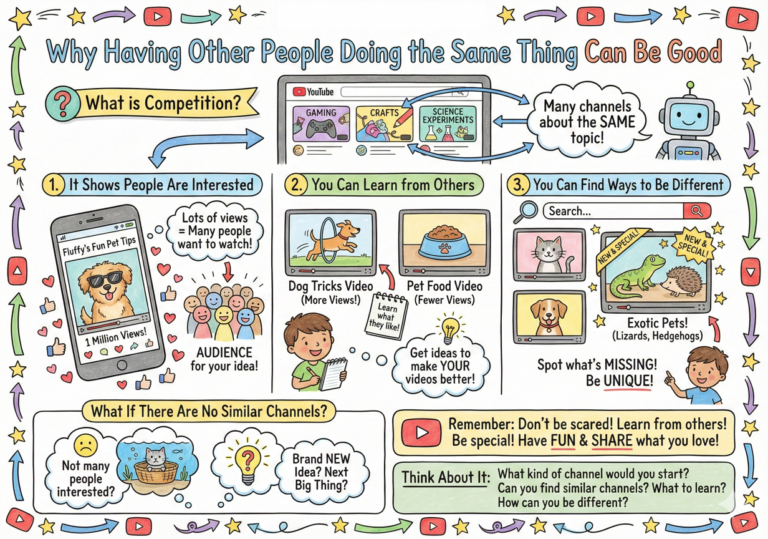
Competition is when different people or businesses offer similar things. On YouTube, it’s when there are many channels about the same topic, like gaming, crafts, or science experiments.

Imagine you want to start a channel about pet care tips. If you see lots of popular pet care channels:
Example: If “Fluffy’s Fun Pet Tips” has millions of views, it shows people love pet videos!

By watching other channels in your topic:
Example: You might notice that videos showing how to teach dogs tricks get more views than videos about pet food. This could help you decide what to make videos about!
After watching other channels:
Example: Maybe you notice no one is making videos about exotic pets like lizards or hedgehogs. This could be your chance to be unique!

If you can’t find any channels about your idea:
Example: If you want to make videos about “Underwater Basket Weaving for Cats” and find no similar channels, it might be because not many people are looking for that. But who knows? Maybe you’ve found the next big thing!



Remember, the most important thing is to have fun and share what you love!
Twelve-year-old Amara Singh had a secret superpower: she could turn ordinary ingredients into the most extraordinary cupcakes anyone had ever tasted. Her chocolate-mint cupcakes with edible glitter had become legendary at family gatherings, and her rainbow swirl creations could make her grumpy teenage brother actually smile.
“You should totally start a YouTube channel!” her best friend Kai suggested, watching Amara pipe perfect buttercream flowers onto a batch of lemon cupcakes. “Your baking is amazing!”
Amara’s eyes lit up with excitement, but then her face fell. “I don’t know, Kai. I just searched ‘baking channels’ on YouTube, and there are like… thousands of them. ‘Tasty,’ ‘How To Cake It,’ ‘Preppy Kitchen’—huge channels with millions of subscribers. Why would anyone watch mine when there are already so many famous bakers?”
“Maybe that’s exactly why you should start one,” said Amara’s older sister Priya, who was studying business in college and always had opinions about everything. “What if all those channels mean something good instead of something bad?”
“How could competition be good?” Amara asked, genuinely confused.
Priya grinned. “Let me show you something. It’s called competition validation, and it’s one of the most important concepts in business.”
That evening, Priya sat down with Amara and her laptop. “Okay, detective time. Let’s investigate your competition scientifically.”
DISCOVERY #1: COMPETITION PROVES DEMAND
“First,” Priya said, pulling up YouTube analytics, “let’s see what all these baking channels tell us about audience demand.”
They searched for baking channels and started looking at view counts:
“Look at these numbers,” Priya pointed out. “Do you know what this tells us?”
Amara studied the screen. “That… lots of people watch baking videos?”
“Exactly! If baking channels regularly get millions of views, that means there’s a HUGE audience of people who love watching baking content. Competition doesn’t mean the market is full—it means the market is proven!”
Amara felt a spark of excitement. “So all these successful channels prove that people want to watch baking videos?”
“Bingo! If you wanted to start a channel about something super obscure, like… I don’t know, ‘How to Clean Vintage Typewriters,’ and you found zero competition, that might actually be a bad sign. It could mean nobody cares about vintage typewriters.”
DISCOVERY #2: COMPETITORS ARE FREE RESEARCH
“Now,” Priya continued, “let’s see what we can learn from your ‘competition.'”
They spent the next hour analyzing popular baking channels, and Amara started taking notes:
“Look at this,” Amara observed. “The most popular videos seem to be either super quick 60-second recipe videos, or really detailed decorating tutorials that are like 15-20 minutes long.”
“What else do you notice?” Priya prompted.
“Most of them focus on cakes and cookies. I don’t see many cupcake-specific channels,” Amara said, getting more excited. “And a lot of them are for advanced bakers. I don’t see many channels teaching kids my age how to bake.”
“You’re becoming a competition detective!” Priya laughed. “What else?”
Amara studied the comment sections. “People keep asking for easier recipes, and for videos that show common mistakes. Oh! And lots of comments are asking for allergy-friendly options—gluten-free, dairy-free stuff.”
DISCOVERY #3: FINDING YOUR UNIQUE ANGLE
“This is where it gets really interesting,” Priya said. “Now that you know what your competitors are doing well, and what their audiences are asking for, what opportunities do you see?”
Amara’s mind started racing. “Well, I could focus specifically on cupcakes instead of all kinds of baking. And I could target kids and teens instead of adults. Plus, I know tons about baking for food allergies because of cousin Maya’s gluten sensitivity.”
“Keep going,” Priya encouraged.
“And what if I showed the mistakes I make? Like, what happens when you overmix batter, or how to fix frosting that’s too runny? Most channels only show perfect results, but I could show the learning process.”
“Now you’re thinking like an entrepreneur!” Priya said. “You’re not copying your competition—you’re finding the gaps they haven’t filled.”
THE COMPETITION TEST
Over the next week, Amara conducted what she called “The Competition Test.” She researched channels in different niches:
HIGH COMPETITION NICHE: General Baking
MEDIUM COMPETITION NICHE: Kids’ Cooking
LOW COMPETITION NICHE: Baking with Unusual Ingredients
NO COMPETITION NICHE: Cupcake Decorating for Pet Birthdays
“I see the pattern now,” Amara told Priya. “High competition usually means high demand. No competition might mean no demand.”
LAUNCHING “CUPCAKE KIDS WITH AMARA”
Armed with her competitive intelligence, Amara launched her channel with a clear strategy:
Her Unique Positioning:
Her first video, “5 Cupcake Mistakes I Made So You Don’t Have To,” got 50,000 views in the first month.
Her second video, “Gluten-Free Birthday Cupcakes That Actually Taste Amazing,” got 150,000 views.
By month three, “Cupcake Kids with Amara” had 25,000 subscribers.
LEARNING FROM COMPETITION ONGOING
But Amara’s real genius was how she continued to use her competition as a resource:
When “Tasty” released a viral cake video, Amara created a cupcake version specifically for her younger audience.
When she noticed other channels struggling with complex decorating techniques, she developed simplified versions perfect for kids.
When a big channel ignored requests for dairy-free options, Amara created an entire series about dairy-free cupcake alternatives.
“I don’t see other channels as enemies anymore,” Amara told Kai six months later as they filmed her latest video. “They’re like… my research team and inspiration board all rolled into one.”
“How so?” Kai asked, adjusting the camera angle.
“Every successful baking channel proves that people love this content. Every comment on their videos tells me what audiences want more of. Every gap in their content is an opportunity for me to fill.”
Amara paused her mixing to face the camera directly. “Plus, when people search for ‘cupcake tutorials,’ they often find multiple channels, including mine. Competition actually helps bring me viewers because it builds the whole category.”
THE COMPETITION REVELATION
A year later, Amara was invited to collaborate with some of the “big” baking channels she had once feared competing against.
“Funny how this worked out,” she told Priya during their weekly business chat. “I was terrified of competition, but it turned out to be my best friend.”
“How do you mean?” Priya asked.
“Competition validated that baking content has a huge audience. It taught me what works and what doesn’t. It showed me exactly where I could be different. And now it’s actually bringing me opportunities to work with other creators.”
Amara pulled up her analytics. “Look at this—when big baking channels post videos, it actually increases views for smaller channels like mine too. Rising tide lifts all boats.”
“What would you tell other kids who are afraid of competition?” Priya asked.
Amara thought for a moment. “Competition isn’t your enemy—it’s your proof that people want what you’re offering. Use it like a free research service. Learn from what others do well, find what they’re missing, and then add your own special twist.”
“And what if there’s no competition at all?”
“Be really careful,” Amara laughed. “It might mean you’ve discovered the next big thing… or it might mean nobody wants that thing. Do your homework first.”
As Amara prepared for her next video—”Cupcakes That Look Like Your Favorite Video Game Characters”—she smiled thinking about how wrong she’d been about competition.
Her “competitors” hadn’t blocked her success. They’d been the stepping stones that led to it.
And in the business world, Amara had learned, sometimes the best way to stand out isn’t to avoid the crowd—it’s to find your unique place within it.
Verse 1:
Thought I had a brand new plan
To be a YouTube star, oh man
But wait, there’s channels just like mine
Should I give up? Nah, that’s not fine
Pre-Chorus:
‘Cause competition’s not so bad
It’s an opportunity to be had
Chorus:
Competition’s cool, it shows there’s demand
People want what you’ve got on hand
Learn from others, then add your spin
That’s how you’ll stand out and win
Don’t fear the crowd, embrace the scene
On YouTube’s stage, you can still beam
Verse 2:
Watch and learn, see what they do
Then make it better, make it you
If no one’s there, ask yourself why
Maybe your idea’s too shy
(Pre-Chorus)
(Chorus)
Bridge:
Be it pets or games or crafty stuff
The world is big, there’s room enough
So fire up that camera, let your light shine
Your unique voice will do just fine
(Chorus)
Outro:
Competition’s cool, don’t you see?
It’s a chance to be the best you can be