
![]()
Have you ever watched a squirrel gathering nuts for winter, or noticed how a library keeps lots of books on its shelves?
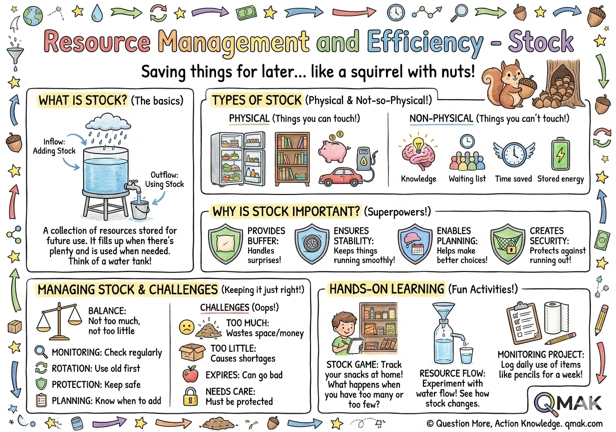
These are examples of stock – resources that are collected and stored for future use.
Just like a squirrel’s collection of nuts or a library’s collection of books, stock is something we keep in reserve until we need it.

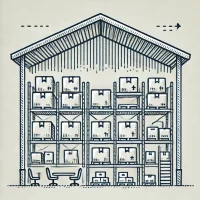
Stock is any collection of resources that builds up over time within a system.
Think of it like a water tank that can be filled up when there’s plenty of water available, and drawn from when water is needed.
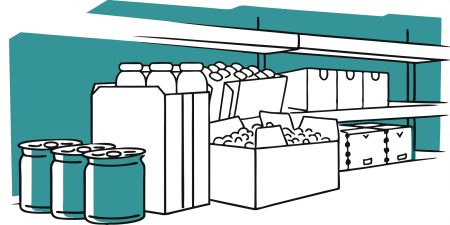
Stock can be physical things you can touch (like food in a pantry), or things you can’t touch (like a list of customers waiting for service).
There are different types of stock:
Stock plays important roles in different types of systems:
Stock helps systems work better in several ways:
Provides Buffer: Having stock helps handle unexpected changes or demands
Ensures Stability: Regular access to stored resources keeps systems running smoothly
Enables Planning: Knowing your stock levels helps make better decisions
Creates Security: Having reserves provides protection against shortages
Good stock management involves:
Managing stock can be tricky for a number of reasons:
Remember, stock is a fundamental part of how systems work. Whether it’s a squirrel’s nut collection, a library’s books, or a store’s inventory, understanding how to manage stock helps systems run more smoothly and reliably. Good stock management means having enough resources when you need them, without wasting space or resources on excess stock you don’t need.
Toy Story offers a delightful exploration of stock through Andy’s toy collection, where each toy represents a resource within an interconnected system.
Through Woody’s crisis when Buzz Lightyear arrives, students witness how changes in stock – whether additions or potential losses – can dramatically impact system dynamics.
The film cleverly demonstrates stock management through the toys’ shifting roles and values, from Woody’s status as a cherished resource suddenly threatened with obsolescence to the integration of new “stock” in the form of Buzz.
As viewers follow the toys’ adventures, they learn how stocks must be maintained and adapted to remain valuable within a system, illustrated by the toys’ constant efforts to stay relevant in Andy’s world.
Through this animated lens, students gain an accessible framework for understanding how resources accumulate, deplete, and influence the behavior of complex systems, whether those systems are toy collections or real-world resource networks.