
![]()
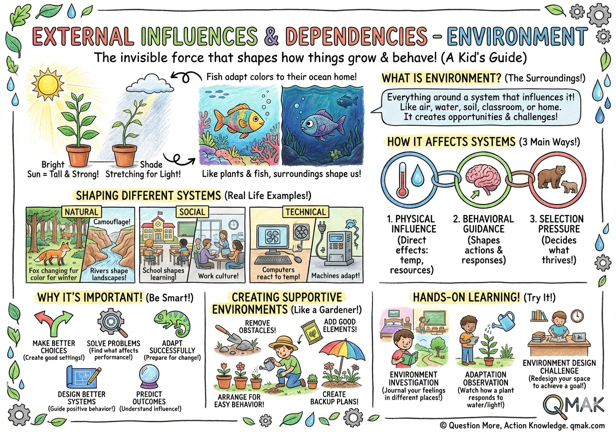
Have you ever noticed how a plant grows differently depending on where it’s placed?
In bright sunlight, it might grow tall and strong, but in shade, it might become thin and stretched as it searches for light.
Or how fish in different parts of the ocean develop different colors and features to match their surroundings?
This is the power of environment – the way our surroundings shape how things grow, develop, and behave.

Environment is everything that surrounds and influences a system – like the air, water, and soil around a plant, or the classroom, home, and neighborhood around a student.
It’s like an invisible force that guides how things develop and behave, creating both opportunities and challenges.
There are three main ways environment affects systems:
Direct effects of surroundings (like temperature or available resources)
How environment shapes actions and responses
How environment determines what survives and thrives
Let’s explore how environment affects various types of systems:
Understanding environment helps us:
Make Better Choices: Create settings that support desired outcomes
Solve Problems: Identify environmental factors affecting system performance
Adapt Successfully: Prepare for and respond to environmental changes
Design Better Systems: Create environments that guide positive behavior
Predict Outcomes: Understand how environment influences results
Just like a gardener creates the right conditions for plants to grow, we can shape environments to support success:
Remember, environment is like the stage on which all systems perform – it can either support success or create challenges. Just as a fish needs clean water to thrive and a plant needs good soil to grow, every system needs the right environment to perform at its best.
By understanding and working with environment, we can create better conditions for success in any system.
Avatar provides a stunning exploration of environmental systems through its portrayal of Pandora, where biological interconnectedness isn’t just a concept but a literal neural network linking all living things.
Through the contrast between the Na’vi’s harmonious relationship with their environment and humans’ extractive approach, students witness how different mental models about the environment lead to radically different systems of organization and behavior.
The film’s depiction of Pandora’s ecosystem – where every creature and plant plays a vital role in maintaining balance – demonstrates how environmental factors shape everything from cultural practices to technological development.
As viewers follow Jake Sully’s journey from observer to participant in this complex system, they learn how environmental understanding requires shifting from seeing nature as a resource to be exploited to recognizing it as a delicate web of relationships that sustains all life.
This visual spectacle makes abstract concepts about environmental systems tangible and memorable.
Verse 1:
Watch the plant reach for the light
Fish in depths both dark and bright
Every living thing we see
Shaped by what surrounds it be
Pre-Chorus:
Like a stage that sets the scene
More than what is simply seen
Forces guiding how we grow
More than we might ever know
Chorus:
Surrounding Songs play soft and strong
Teaching us where we belong
Shaping how we grow and change
Surrounding Songs arrange our way
Verse 2:
Classroom walls and garden soil
Weather patterns, ocean roils
Each space writes its secret code
On everything within its hold
(Pre-Chorus)
(Chorus)
Bridge:
Between the being and becoming
Life’s wisdom in the space surrounding
Every choice and every change
By invisible hands arranged