
![]()
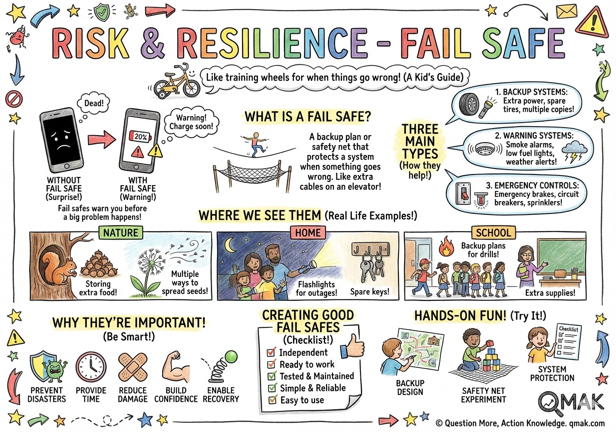
Have you ever seen training wheels on a bicycle?
They’re there to prevent the bike from tipping over while someone learns to ride.
Or maybe you’ve noticed that elevators have multiple cables holding them up, not just one.
These are examples of fail safes – backup systems that kick in when something goes wrong to prevent bigger problems.
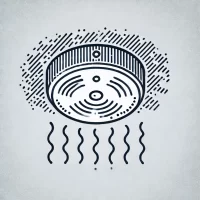
A fail safe is like a safety net or backup plan that helps protect a system when something goes wrong. Just like how a phone’s battery warning lets you know when to charge it before it dies, fail safes help prevent or reduce problems when things don’t work as planned.
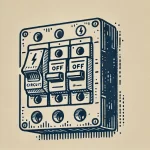
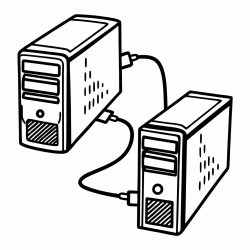
There are different types of fail safes:
Let’s explore how fail safes appear in various systems:
Fail safes help systems by:
Preventing Disasters: Stopping small problems from becoming big ones
Providing Time: Giving warning before complete failure
Reducing Damage: Limiting the impact when things go wrong
Building Confidence: Creating trust in system safety
Enabling Recovery: Helping systems bounce back after problems
Effective fail safes need to be:
Remember, Fail safes are like insurance for our systems – we might not need them often, but they’re incredibly important when things go wrong. Just like training wheels help new cyclists stay safe while learning, good fail safes help our systems stay reliable and recover from problems when they happen.
Just like training wheels help new cyclists stay safe while learning, good fail safes help our systems stay reliable and recover from problems when they happen.
Gravity provides a gripping exploration of fail-safe systems through Dr. Ryan Stone’s desperate fight for survival in space.
Through her harrowing journey after a catastrophic accident, students witness how backup systems and redundant safety measures become crucial when primary systems fail.
The film demonstrates fail-safe thinking in action as Stone moves from one contingency plan to another – from emergency oxygen supplies to backup thrusters to alternative spacecraft – showing how layered safety systems can create paths to survival even when disaster strikes.
As viewers follow her intense space-walk sequences, they see how each fail-safe mechanism, though seemingly redundant during normal operations, becomes a vital link in the chain of survival when things go wrong.
The unforgiving environment of space provides the perfect backdrop for understanding why complex systems need multiple layers of protection, as even small failures can cascade into life-threatening situations without proper backup measures.