
Novelty Bias: Why We're Drawn to the Shiny and New

Have you ever noticed how exciting a new phone feels right after you get it, only to become “just your phone” a few weeks later? 

Or how you might choose a new restaurant over your reliable favorite spot, just because it’s new? 

That’s novelty bias in action – our brain’s natural tendency to be attracted to what’s new and different, often at the expense of what’s familiar and proven.

Think of your attention like a spotlight. While everything in the room might be equally important, that spotlight tends to automatically swing toward whatever’s new and different. 

It’s like how a new student in class instantly captures everyone’s attention, even if they haven’t done anything particularly interesting yet.

Why Are We Drawn to Novelty?

Our attraction to novelty isn’t just a modern phenomenon – it’s wired into our brains for good reasons:

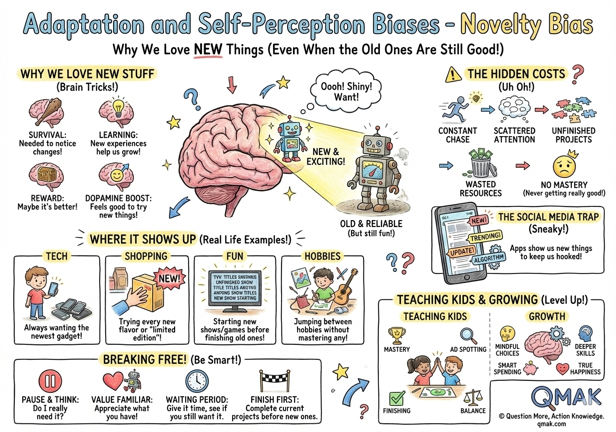
  1. Survival Advantage: Our ancestors needed to notice changes in their environment quickly.
  2. Learning Opportunity: New experiences help our brains grow and develop.
  3. Potential Reward: Novel experiences might lead to better outcomes than our current situation.
  4. Dopamine Release: Our brains actually reward us chemically for exploring new things.
dopamine-release-from-the-brain

How Novelty Bias Shows Up in Daily Life

This bias influences many areas of our lives:

1. In Technology

  • Always wanting the latest phone model
  • Downloading new apps just because they’re trending
  • Switching to new platforms before really needing to
  • Abandoning perfectly good devices for newer versions
technology

2. In Consumer Behavior

  • Being drawn to products with “New!” labels
  • Trying every new flavor or limited edition
  • Shopping at new stores just because they’re new
  • Choosing new brands over trusted ones
consumer-behavior

3. In Entertainment

  • Starting new TV shows before finishing current ones
  • Buying new games before completing others
  • Following new social media trends
  • Switching to new music streaming services
tv-shows

4. In Personal Development

  • Starting new hobbies without mastering current ones
  • Jumping between different productivity systems
  • Trying every new workout trend
  • Switching between different learning methods
personal-development

The Hidden Costs of Always Chasing New

Our attraction to novelty can have significant consequences. When we constantly chase what’s new, we often fail to develop deep expertise or appreciation for anything. 

This constant switching can lead to scattered attention, unfinished projects, and wasted resources. We might abandon perfectly good solutions just because something newer comes along, or miss out on the benefits of mastery because we never stick with anything long enough. 

Moreover, the constant pursuit of novelty can create a cycle of temporary satisfaction followed by a need for another “new thing” fix.

Constant Chase of Novelty Scattered Attention Never Reaching Mastery Unfinished Projects Wasted Resources

The Social Media Factor

Social media platforms purposely exploit our novelty bias:

  1. Infinite Scrolling: Always showing us something new to keep us engaged
  2. Algorithm Updates: Constantly changing what we see to maintain novelty
  3. Feature Releases: Regular updates and new features to keep us interested
  4. Trending Content: Highlighting what’s new over what’s valuable
scrolling-on-social-media

Breaking Free from Novelty's Pull

before-jumping-to-something-new--pause-and-evaluat

Practice Mindful Consumption

Before jumping to something new, pause and evaluate whether you really need it. Consider if your current solutions are actually working fine, and whether the new option offers genuine improvements or just the excitement of novelty.

value-the-familiar

Value the Familiar

Take time to appreciate what you already have and know. Often, mastery and deeper understanding of familiar things can provide more satisfaction than the temporary thrill of something new.

implement-a-waiting-period

Implement a Waiting Period

When tempted by something new, give yourself a cooling-off period. This helps separate genuine value from the initial excitement of novelty.

properly-conclude-current-projects-before-starting

Finish What You Start

Make a rule to complete or properly conclude current projects before starting new ones.

Teaching Kids About Novelty Bias

  1. Explore the Value of Mastery
    Help children understand that while new things are exciting, there’s special value in becoming really good at something through practice.
  2. Discuss Advertising Tactics
    Show how marketers use “new and improved” claims to trigger our novelty bias.
  3. Encourage Completion
    Help kids develop the habit of finishing current activities or projects before starting new ones.
  4. Balance New and Familiar
    Create a healthy mix of novel experiences and comforting routines.

Using Awareness for Personal Growth

Understanding novelty bias can lead to better life choices:

1. Thoughtful Innovation

Embracing new things when they truly offer value, not just because they’re new.

2. Deeper Learning

Staying with subjects or skills long enough to develop real expertise.

3. Better Resource Management

Making more conscious decisions about purchases and time investments.

4. Increased Satisfaction

Finding joy in mastery and familiarity, not just novelty.

Remember, being attracted to what’s new isn’t inherently bad – it’s part of what makes us human and helps us grow and adapt. The key is finding the right balance between embracing novelty and appreciating what we already have.

Next time you feel pulled toward something just because it’s new, pause and ask yourself: “Am I interested in this because it’s truly valuable, or just because it’s novel?” Sometimes, the best new thing is a deeper appreciation of what you already have.

A4 Printables: Cheatsheet

Moana provides a vibrant exploration of novelty bias through the story of a young leader drawn to explore beyond her island’s reef.

Through Moana’s irresistible attraction to the ocean despite her community’s warnings, students witness how our innate curiosity about new things can drive innovation and discovery.

The film demonstrates novelty bias through Moana’s constant pull toward the unknown – from collecting seashells as a toddler to ultimately becoming a master wayfinder – showing how attraction to novelty can lead to breakthrough solutions when existing systems fail.

As viewers follow her journey to restore the heart of Te Fiti, they see how her natural draw toward new experiences helps her discover lost knowledge about her people’s voyaging heritage and find creative solutions to her island’s environmental crisis.

Through its celebration of exploration and discovery, the film shows how novelty bias, when properly channeled, can become a powerful force for positive change, pushing us to look beyond comfortable but limiting boundaries to find answers in unexpected places.

Movie Recommendation: 127 Hours (2010)

127 Hours provides a gripping examination of novelty bias through Aron Ralston’s harrowing experience in Utah’s remote canyons.

Through Aron’s fateful decision to explore alone without telling anyone his plans, students witness how the allure of new experiences can override common sense and safety considerations.

The film powerfully demonstrates how novelty bias can blind us to familiar warnings and essential precautions as Aron, an experienced climber, ignores basic safety protocols in pursuit of another thrilling adventure.

His 127-hour ordeal trapped by a boulder, captured through intimate video diaries and hallucinations, forces him to confront how his constant chase for novel experiences has isolated him from meaningful connections.

Through this intense true story, viewers learn how novelty bias can transform from an engine of discovery into a dangerous form of overconfidence, making it particularly relevant for discussions about balancing the excitement of new experiences with proper risk assessment.