Have you ever noticed that there’s often more than one way to do something?
Maybe you and a friend have different strategies for solving a math problem, or you’ve seen people from different cultures celebrate similar holidays in their own unique ways.
This idea – that different things or approaches can lead to the same outcome – is called equivalence.
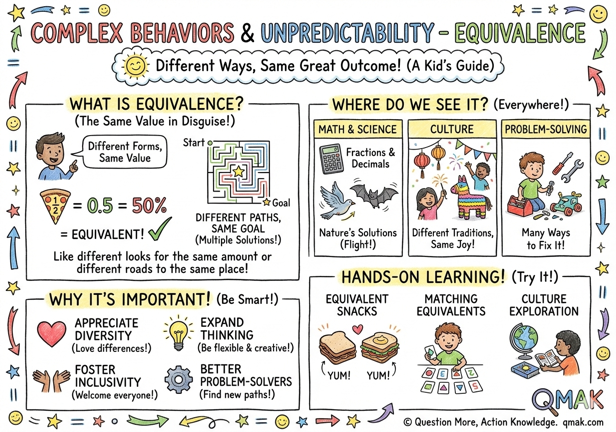
What is Equivalence?
Equivalence is all about recognizing that while things may seem different on the surface, they can actually be similar or equal in important ways.
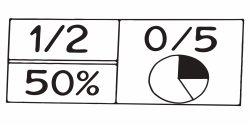
It’s kind of like how 1/2 and 0.5 look different, but they’re equivalent because they represent the same value or amount.
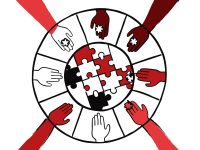
Equivalence reminds us that there’s beauty and value in diversity.
It shows us that even though people, cultures, or solutions might seem totally different from each other, they can sometimes be equivalent – leading to the same great results or experiences.
Where Do We See Equivalence?
Equivalence is all around us, in all sorts of places:
In math, when we learn that fractions, decimals, and percentages are just different ways of representing the same number or value.
In science, when we study how different animals have evolved equivalent ways of adapting to their environments, like how birds and bats both developed wings for flight.
In different cultures, where we see that many traditions, celebrations, or ways of life are equivalent, even if they look different on the surface.
In problem-solving, when we explore all the different but equivalent ways we could tackle a challenge or reach a goal.
Why is Equivalence Important?
Understanding equivalence is important for a few key reasons:
1.
It helps us appreciate diversity. When we recognize that different approaches can be equally valid or valuable, we’re more likely to be open-minded and accepting of people who are different from us.
2.
It expands our thinking. By considering equivalent solutions or perspectives, we train our brains to be more flexible and creative in how we approach problems or challenges.
3.
It fosters inclusivity. Equivalence reminds us that there’s no single “right” way to do things, which helps us be more inclusive and welcoming of different ideas, cultures, and ways of life.
4.
It makes us better problem-solvers. When we get stuck on one approach, recognizing equivalence allows us to explore other paths that could be just as effective (or even better!).
Hands-On Learning
One of the best ways to understand equivalence is to experience it for yourself.
Here are some fun activities to try:
Equivalent Snacks
Make the same type of snack (like a sandwich or a fruit salad) using different but equivalent ingredients. For example, one sandwich could have peanut butter and jelly, while another has hummus and vegetables – but they’re both equally delicious and filling!
Matching Equivalents
Gather a collection of objects, pictures, or numbers that represent equivalent values or concepts (like different shapes with the same area, or different ways to represent 1/4). See if you can match up all the equivalents!
Culture Exploration
Research traditions, celebrations, or customs from different cultures around the world. See if you can find examples of how different cultures have developed equivalent ways of marking important events or expressing their values.
Remember, equivalence is all about recognizing that diversity doesn’t have to mean division. By embracing the idea that different things can be equally valuable or lead to the same positive outcomes, we can build a more inclusive, open-minded, and vibrant world for everyone.
Cloud Atlas provides a sweeping exploration of equivalence through its interwoven tapestry of six seemingly disparate stories across time and space.
Through its ambitious narrative structure, students witness how fundamental patterns of human behavior – from acts of oppression to moments of liberation – remain equivalent across vastly different contexts and eras.
The film demonstrates equivalence by showing how a composer’s letters in 1936 can mirror a journalist’s investigation in 1973, or how a clone’s rebellion in Neo Seoul echoes a slave’s fight for freedom in the 1849 Pacific.
As viewers follow these interconnected stories and recurring souls, they learn how recognizing equivalence helps us identify the universal dynamics that shape human systems regardless of their surface differences.
Through its bold suggestion that all human struggles and triumphs are essentially equivalent variations on eternal themes, the film shows why understanding equivalence becomes crucial for recognizing deeper patterns in complex systems.