
Have you ever talked to yourself while solving a hard problem?
Or made a list to remember important things instead of trying to keep them all in your head?
These are examples of externalization – taking what’s in our minds and putting it into the outside world where we can see, hear, or touch it.

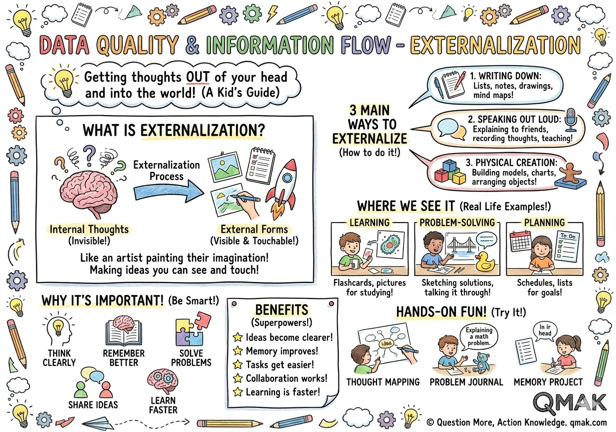
What is Externalization?
Externalization means taking thoughts, ideas, or information out of our heads and putting them into a form we can interact with in the real world.
It’s like turning the invisible thoughts in our minds into visible things we can work with, just like an artist turns their imagination into a painting.
There are three main ways to externalize:
1. Writing Things Down
Making lists
Drawing diagrams
Creating mind maps
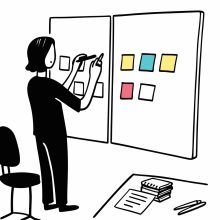
Taking notes
2. Speaking Out Loud
Explaining ideas to others
Talking through problems
Recording thoughts
Teaching concepts
3. Physical Creation
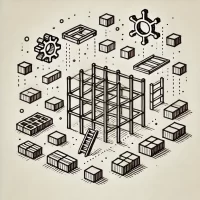
Building models
Making diagrams
Creating charts
Arranging objects
How Externalization Works in Different Systems
Let’s explore how externalization helps in various systems:
Learning Systems
Writing notes during class
Drawing pictures to explain ideas
Making flashcards for study
Creating practice problems
Problem-Solving Systems
Sketching out possible solutions
Talking through challenges
Building prototype models
Making decision trees
Planning Systems
Creating to-do lists
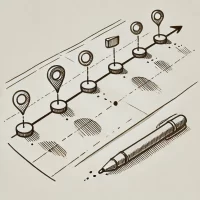
Drawing project timelines
Making event schedules
Writing down goals
Why is Externalization Important?
Externalization helps us:
Think Clearly: See our thoughts more obviously
Remember Better: Keep track of important things
Solve Problems: Work through challenges step by step
Share Ideas: Communicate with others more effectively
Learn Faster: Understand concepts more deeply
Benefits of Good Externalization
When we externalize well:
Ideas become clearer
Memory improves
Tasks get easier
Collaboration works better
Learning happens faster
Hands-On Learning
Thought Mapping Exercise Choose a topic you’re trying to understand or a problem you’re trying to solve. Start by writing the main idea in the center of a page. Then, draw branches connecting related ideas, questions, or possible solutions. Keep adding to your map as new thoughts come up. Notice how seeing your thoughts laid out visually helps you make new connections and understand things better.
Problem-Solving Journal When you face a challenging problem, try talking it through out loud while writing or drawing what you’re thinking. Pretend you’re explaining it to someone else (some programmers even explain problems to rubber ducks!). Keep track of how expressing your thoughts externally helps you find solutions you might have missed when keeping everything in your head.
Memory Enhancement Project Compare how well you remember things when you keep them in your head versus when you write them down or say them out loud. Try remembering a list of items both ways, or learning a new concept using different externalization methods. Notice which approaches help you remember and understand things best.
Remember, externalization is like giving your brain extra help by turning thoughts into things you can see, hear, or touch. Just like how writing down a shopping list helps you remember what to buy better than trying to keep it all in your head, good externalization makes thinking, learning, and problem-solving easier and more effective.
Arrival offers a fascinating exploration of externalization through linguist Louise Banks’ methodical efforts to communicate with beings whose language defies human comprehension.
Through her painstaking process of translating alien circular symbols into visual diagrams and patterns, students witness how making abstract concepts tangible can unlock hidden layers of meaning and understanding.
The film demonstrates externalization as Louise moves from simple pictograms to complex temporal maps, showing how rendering internal concepts into external forms allows us to analyze and manipulate ideas too complex to hold in mind alone.
As viewers follow her journey to grasp the aliens’ non-linear perception of time through increasingly sophisticated visual models, they learn how externalization can help bridge seemingly impossible gaps in understanding.
Through its thoughtful portrayal of first contact, the film shows why externalizing complex ideas becomes crucial for managing and communicating within systems that exceed our natural cognitive capabilities.