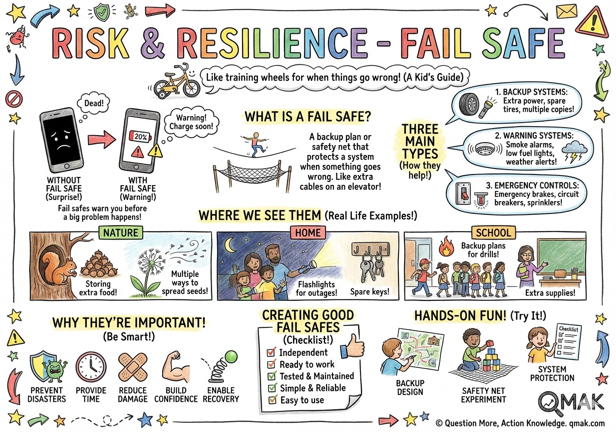


Fail Safe

Have you ever seen training wheels on a bicycle? 

They’re there to prevent the bike from tipping over while someone learns to ride. 

Or maybe you’ve noticed that elevators have multiple cables holding them up, not just one. 

These are examples of fail safes – backup systems that kick in when something goes wrong to prevent bigger problems.
What is a Fail Safe?

A fail safe is like a safety net or backup plan that helps protect a system when something goes wrong. Just like how a phone’s battery warning lets you know when to charge it before it dies, fail safes help prevent or reduce problems when things don’t work as planned.

Fail Safe Protection Without Fail Safe ! Device Dead With Fail Safe 20% left Charged Fail safes help prevent problems by warning you before failure occurs

There are different types of fail safes:

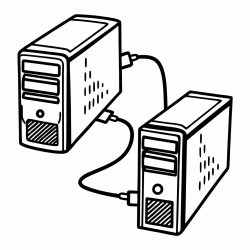
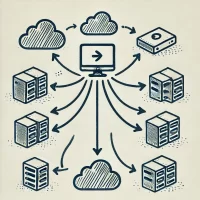
DALL·E 2024-11-02 20.42.17 - A simple, hand-drawn 2D illustration representing multiple computer backups. Show a central computer connected to several backup drives or cloud icons

1. Backup Systems

  • Extra power generators
  • Spare tires in cars
  • Multiple computer backups
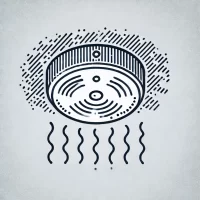
DALL·E 2024-11-02 20.42.52 - A simple, hand-drawn 2D illustration representing smoke detectors. Show a ceiling-mounted smoke detector with small wavy lines or signals indicating d

2. Warning Systems

  • Smoke detectors
  • Low fuel lights
  • Weather alerts
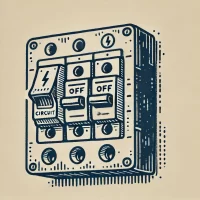
DALL·E 2024-11-02 20.43.27 - A simple, hand-drawn 2D illustration representing circuit breakers. Show a circuit breaker panel with switches or levers, with one of them highlighted

3. Emergency Controls

  • Emergency brakes
  • Circuit breakers
  • Fire sprinklers

How Fail Safes Work in Different Systems

Let’s explore how fail safes appear in various systems:

Natural Systems

  • Animals store extra food for winter
  • Plants have multiple ways to spread seeds
  • Bodies have backup organs (two kidneys)
  • Ecosystems maintain biodiversity
DALL·E 2024-11-02 20.44.33 - A simple, hand-drawn 2D illustration representing an animal storing extra food for winter. Show a small animal, like a squirrel, gathering and placing

School Systems

  • Multiple copies of important documents
  • Backup plans for fire drills
  • Alternative lunch options
  • Extra supplies for activities
DALL·E 2024-11-03 06.19.53 - A simple, hand-drawn 2D icon representing alternative lunch options for a school canteen. Show a variety of small food items such as a wrap, a piece o

Home Systems

  • Flashlights for power outages
  • Spare house keys
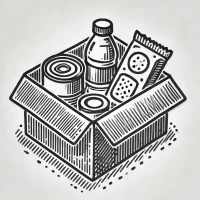
  • Emergency food supplies
  • Multiple smoke detectors
DALL·E 2024-11-03 06.20.47 - A simple, hand-drawn 2D icon representing emergency food supplies. Show a box or container with basic food items like canned goods, a bottle of water,

Why are Fail Safes Important?

Fail safes help systems by:

Preventing Disasters: Stopping small problems from becoming big ones

Providing Time: Giving warning before complete failure

Reducing Damage: Limiting the impact when things go wrong

Building Confidence: Creating trust in system safety

Enabling Recovery: Helping systems bounce back after problems

Creating Good Fail Safes

Effective fail safes need to be:

  • Independent from the main system
  • Ready to work at any time
  • Regularly tested and maintained
  • Simple and reliable
  • Easy to understand and use
a-system-with-a-back-up

Hands-On Learning

  1. Backup System Design
    Choose something important in your daily life – like getting to school, completing homework, or staying in touch with friends. Create a diagram showing your current system and all the things that could go wrong. Then design backup plans for each potential problem. For example, if your usual way to school isn’t available, what are your backup routes? Make sure to test your backup plans when you don’t need them, so you know they’ll work when you do.
  2. Safety Net Experiment
    Set up a simple experiment to demonstrate how fail safes work. Try building a tower with blocks, but add support structures that catch falling pieces. Or create a marble run with multiple paths to the finish, so if one path gets blocked, the marble can still complete the course. Notice how having backups makes the system more reliable and resilient.
  3. System Protection Project
    Pick a system you use regularly – it could be your study routine, a favorite game, or a daily chore. Identify the critical points where things could go wrong, then create and implement fail safes for each one. Keep track of when your fail safes activate and how well they work. This helps you understand how to build better protection into any system.

Remember, Fail safes are like insurance for our systems – we might not need them often, but they’re incredibly important when things go wrong. Just like training wheels help new cyclists stay safe while learning, good fail safes help our systems stay reliable and recover from problems when they happen.

Just like training wheels help new cyclists stay safe while learning, good fail safes help our systems stay reliable and recover from problems when they happen.

A4 Printables: Cheatsheet

Film Recommendation: Gravity (2013)

Gravity provides a gripping exploration of fail-safe systems through Dr. Ryan Stone’s desperate fight for survival in space.

Through her harrowing journey after a catastrophic accident, students witness how backup systems and redundant safety measures become crucial when primary systems fail.

The film demonstrates fail-safe thinking in action as Stone moves from one contingency plan to another – from emergency oxygen supplies to backup thrusters to alternative spacecraft – showing how layered safety systems can create paths to survival even when disaster strikes.

As viewers follow her intense space-walk sequences, they see how each fail-safe mechanism, though seemingly redundant during normal operations, becomes a vital link in the chain of survival when things go wrong.

The unforgiving environment of space provides the perfect backdrop for understanding why complex systems need multiple layers of protection, as even small failures can cascade into life-threatening situations without proper backup measures.