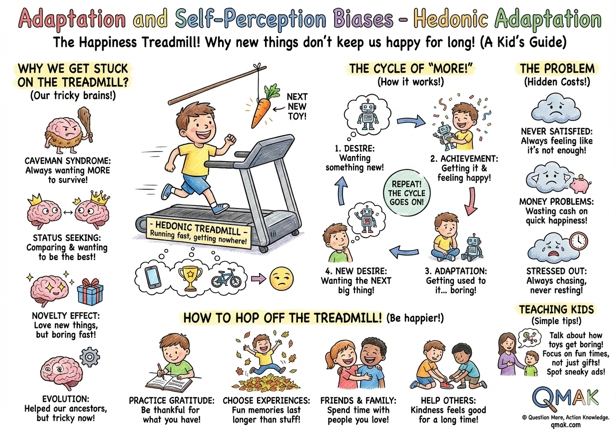


Have you ever noticed how that shiny new phone loses its excitement after a few weeks?
Or how that dream job starts feeling just like any other job after a few months?
If so, you’ve experienced hedonic adaptation, also known as the hedonic treadmill – our mind’s sneaky tendency to adapt to positive changes, leaving us constantly chasing the next source of happiness.
Think of it like being on a treadmill: no matter how fast you run or how far you go, you always end up in the same place.
That’s exactly how hedonic adaptation works with happiness – we keep chasing new things thinking they’ll make us happier, but we quickly adjust to each new normal, leaving us running in place emotionally.





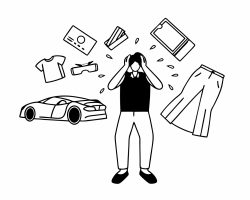





 Someone who realized that accumulating more possessions wasn’t bringing lasting happiness, so they simplified their life and found joy in experiences and relationships instead.
 A high-powered executive who left a prestigious position to pursue more meaningful work, finding sustainable satisfaction in making a difference rather than chasing promotions.
 Someone who broke free from the cycle of constant upgrading by focusing on quality over quantity and finding satisfaction in what they already have.
 1. Better Decision-Making
 2. Improved Relationships
 3. Financial Wisdom
 4. Sustainable Happiness