

![]()
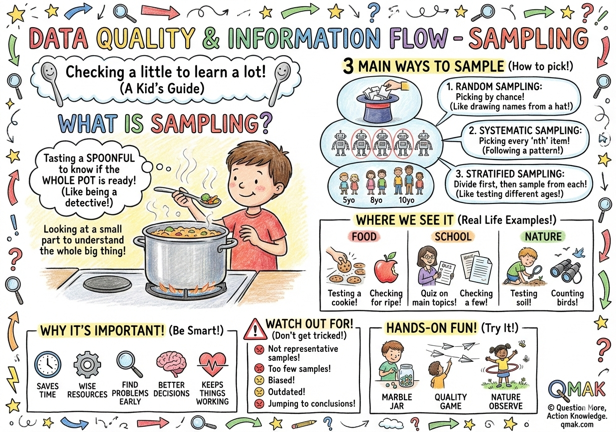
Have you ever tasted a spoonful of soup to check if the whole pot is ready?
Or picked one apple from a tree to see if they’re ripe?
These are examples of sampling – checking a small part of something to learn about the whole thing.
It’s like being a detective who can understand the big picture by looking at just a few careful clues!

Sampling means looking at a small part of something to understand what the whole thing is like. Instead of checking everything (which might take too long or be impossible), we choose some representative pieces to examine carefully.
There are three main ways to sample:
Let’s explore how sampling helps in various systems:
Sampling helps us:
Save Time: Check things quickly
Use Resources Wisely: Test efficiently
Find Problems Early: Spot issues before they spread
Make Better Decisions: Understand the big picture
Keep Things Working: Monitor system health
Good sampling needs:
Be careful about:
Remember, sampling is like having a smart shortcut to understand big things by looking carefully at smaller parts. Just like tasting one spoonful of soup can tell you if the whole pot needs more seasoning, good sampling helps us understand and manage systems without having to check every single piece.
The key is choosing the right samples and understanding what they can tell us about the whole picture.
The Big Short provides a brilliant exploration of sampling through its portrayal of outsider investors who discover systemic financial fraud by examining small but telling segments of the housing market.
Through Michael Burry’s meticulous analysis of individual mortgage loans and Mark Baum’s street-level investigation of Florida real estate, students witness how carefully chosen samples can reveal hidden truths about massive systems.
The film demonstrates sampling as the protagonists piece together the coming crisis through strategic data points – from exotic dancer homeowners to strawberry pickers with million-dollar loans – showing how well-selected samples can expose patterns invisible at the macro level.
As viewers follow these investigators connecting dots that others miss, they learn how sampling can either illuminate or obscure systemic problems depending on whether the samples are representative or cherry-picked.
Through its darkly humorous take on financial detective work, the film shows why understanding sampling becomes crucial for uncovering truth in complex systems too large to analyze in their entirety.