

![]()
Have you ever wondered how toy manufacturers know their toys won’t break during play?
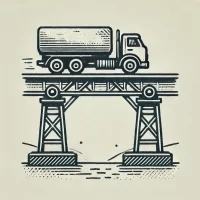
Or how bridge builders ensure their bridges can handle heavy traffic and strong winds?
They use stress testing – deliberately putting things under pressure to see how well they hold up and find any weak spots before they become real problems.
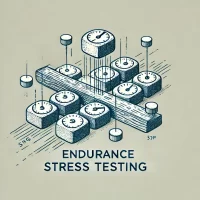
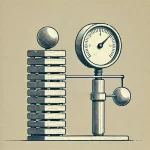
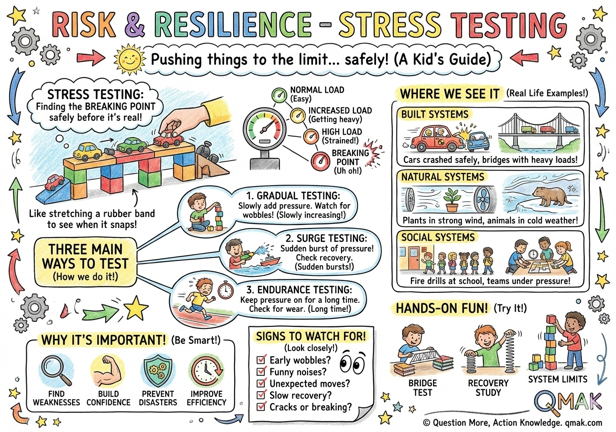
Stress testing means purposely pushing a system to its limits to see how it handles pressure and discover where it might fail.
It’s like stretching a rubber band to see how far it can go before it snaps, but doing it carefully and on purpose so we can learn from what happens.
There are three main ways to stress test:
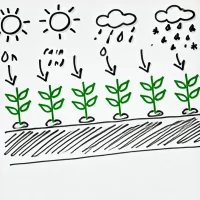
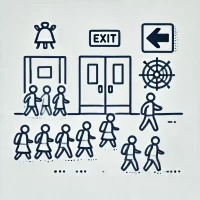
Let’s see how stress testing works in various systems:
Stress testing helps us:
Find Weaknesses: Discover problems before they cause failures
Set Limits: Know how much pressure systems can handle
Build Confidence: Trust that systems will work under pressure
Improve Efficiency: Time actions to align with favorable cycle phases
Prevent Disasters: Stop small problems from becoming big ones
When stress testing, look for:
Remember, Stress testing is like being a detective for systems – we carefully look for clues about where problems might happen by testing things before they become real emergencies.
Just like testing a bridge before cars drive on it, good stress testing helps us build stronger, safer systems that we can trust when we need them most.
Apollo 13 offers a gripping examination of stress testing through its portrayal of how an unexpected explosion forces NASA to push every system to its absolute limit.
Through the crew and ground control’s desperate improvisation to bring three astronauts home, students witness how real-world stress testing often occurs not in simulations but in crisis situations that expose both hidden weaknesses and unexpected strengths.
The film demonstrates stress testing as the team must repurpose the Lunar Module beyond its design parameters, conserve power beyond specified minimums, and adapt procedures for scenarios never anticipated in training.
As viewers follow the increasingly creative solutions required for survival – from jerry-rigging carbon dioxide scrubbers to calculating new re-entry trajectories – they learn how systems reveal their true capabilities only when pushed to their limits.
Through its true story of survival against astronomical odds, the film shows why understanding how systems perform under extreme stress becomes crucial for building genuine resilience rather than assumed reliability.