

![]()
In the complex tapestry of life, events and phenomena are often intertwined, making it challenging to distinguish between correlation and causation.
Understanding this crucial distinction is essential for effective problem-solving, decision-making, and personal growth.
In this article, we’ll explore the concepts of correlation and causation, their differences, and how they can be applied to navigate the complexities of the world around us. We’ll also delve into strategies for teaching these important principles to children, helping them develop critical thinking skills that will serve them well throughout their lives.

![]()
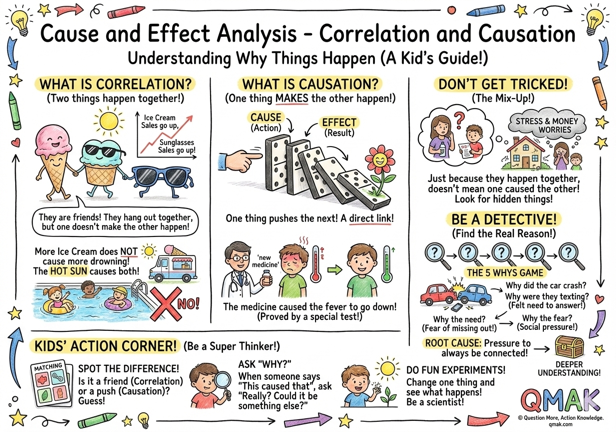
Correlation is a statistical term that describes the relationship between two variables, often measured by a correlation coefficient ranging from -1 to 1. This coefficient indicates the strength and direction of the relationship between the variables.
For example, if we were to plot the relationship between height and weight in a group of people, we would likely find a positive correlation. As height increases, weight tends to increase as well. However, this correlation is not perfect, as other factors such as age, gender, and body composition also influence weight.
It’s important to note that correlation does not imply causation. Just because two variables are correlated does not mean that one causes the other. For instance, there may be a correlation between ice cream sales and drowning incidents, but this does not mean that eating ice cream causes drowning. Instead, both variables are likely influenced by a third factor: hot weather.

![]()
Causation, on the other hand, refers to a cause-and-effect relationship between two variables. In other words, one variable directly influences or causes changes in the other variable.
Determining causation requires more than just observing a correlation. It involves conducting controlled experiments or studies that isolate the variables in question and rule out other potential influences.
For example, if we wanted to determine whether a new medication causes a reduction in blood pressure, we would need to conduct a randomized controlled trial. This would involve randomly assigning participants to either receive the medication or a placebo, and then comparing the changes in blood pressure between the two groups.
Confusing correlation and causation can lead to inaccurate assumptions and poor decision-making. When we mistake a correlation for a causal relationship, we risk drawing invalid conclusions and implementing ineffective solutions.
For instance, imagine a study that shows a correlation between high alcohol consumption in parents and low academic success in their children. While it might be tempting to conclude that parental alcohol consumption causes poor academic performance, this study only demonstrates a correlation. It’s possible that other factors, such as socioeconomic status or family stress, influence both variables.
Media reports and even scientific studies sometimes fall prey to this confusion, leading to misleading headlines and misguided recommendations. It’s crucial to approach such claims with a critical eye and to seek out additional evidence before drawing conclusions.
When examining causation, it’s important to distinguish between proximate cause and root cause. The proximate cause is the immediate reason something happens, while the root cause is the deeper, underlying reason.
For example, if a car accident occurs because the driver was texting, the proximate cause would be the driver’s distraction. However, the root cause might be the driver’s addiction to their phone or a broader cultural issue of people feeling pressure to be constantly connected.
To identify the root cause, a helpful technique is the “five whys” method. This involves asking “why” five times to dig deeper into the reasons behind a problem or event. By uncovering the root cause, we can develop more effective solutions that address the fundamental issues at play.
Helping children understand the difference between correlation and causation is an invaluable gift that can enhance their critical thinking skills and decision-making abilities.
Here are some strategies for introducing these concepts to young minds:
Beyond its applications in critical thinking and decision-making, understanding correlation and causation can also be a powerful tool for personal development.
Here are some ways to leverage these concepts for your own growth:
Recognize Patterns: Observe patterns in your life and identify correlations. For example, if you consistently feel tired on Mondays, consider whether this is correlated to staying up late on Sundays. Recognizing these patterns is the first step in understanding the factors influencing your experiences.
Seek Root Causes: When faced with a personal challenge or recurring issue, use the “five whys” method to uncover the root cause. For instance, if you struggle with procrastination, repeatedly ask “why” to understand the underlying reasons for this behavior. Is it fear of failure? Lack of clarity on the task? By identifying the root cause, you can develop more effective strategies for change.
Avoid False Causality: Be cautious about assuming that correlation implies causation in your personal life. For example, if you start a new diet and feel more energetic, it might be due to the diet itself, or it could be the result of increased physical activity that often accompanies lifestyle changes. Avoid attributing cause where only correlation exists.
Embrace Experimentation: To determine causation in your personal life, embrace a spirit of experimentation. Try different approaches, isolate variables, and observe the outcomes. This process of trial and error can help you identify the strategies and habits that truly contribute to your growth and success.
Events and variables often move together in apparent synchronicity, but this alignment doesn’t always indicate causation. Understanding this distinction helps us navigate complex situations and make better decisions.
By teaching critical thinking about relationships between variables and questioning apparent connections, we develop clearer understanding of the world around us.
Remember, just because two paths run parallel doesn’t mean one created the other.
Objective: To introduce the concept of correlation through fun, fictional examples.
Objective: To help children distinguish between correlation and causation.
Objective: To introduce the concept of controlled experiments in determining causation.
Objective: To apply the concepts of correlation and causation to real-world examples.
Objective: To practice identifying root causes using the “five whys” method.
A Beautiful Mind offers a profound exploration of how humans navigate the complex territory between genuine causation and illusory correlation.
Through John Nash’s brilliant yet troubled journey, students witness both the power and peril of pattern recognition in human thinking.
As Nash’s mathematical genius helps him identify true causal relationships in game theory, his struggle with schizophrenia demonstrates how our minds can also construct false patterns and causations from random events.
The film’s masterful portrayal of Nash’s perspective allows viewers to experience firsthand how easily correlation can be mistaken for causation, particularly when our minds are primed to find meaningful connections.
Through Nash’s eventual development of tools to distinguish reality from delusion, students learn the crucial skill of questioning apparent patterns and rigorously testing assumed causal relationships before accepting them as true.
This deeply human story reminds us that while pattern recognition is essential for understanding our world, critical thinking and careful analysis must guide our conclusions about causation.